
I thought I was a beat, but I was just a boy
Notes on Re-Reading Kerouac in my 50s
Part 7
Part 7
(Read Part 6 here, Part 5 here, Part 4 here, Part 3 here, Part 2 here and Part 1 here.)
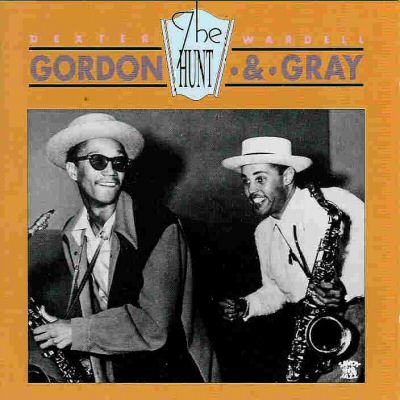
It was On the Road that first introduced me to jazz. The book’s passages on the music are used to create an imagined soundtrack, one of explosive energy and appetite.
“They ate voraciously,” Sal says of Dean, Marylou and Ed, who have just raced east to find Sal, “as Dean, sandwich in hand, stood bowed and jumping before the big phonograph, listening to a wild bop record I had just bought called ‘The Hunt,’ with Dexter Gordon and Wardell Gray blowing their tops before a screaming audience that gave the record fantastic frenzied volume” (113).
And, yes, “The Hunt” is a nine-minute thrill ride. Called an extended saxophone duel by some critics, Gordon and Hunt press each other forward, the rhythm section pressing the accelerator pedal, the crowd revved and rowdy. It’s a “mad” performance, to borrow a term from Kerouac, and is every bit the wild bop Sal describes.
Later, in New York, “Dean was having his kicks; he put on a jazz record, grabbed Marylou, held her tight, and bounced against her with the beat of the music. She bounced right back. It was a real love dance” (125) — jazz as mating ritual, which is consistent with the word’s etymology. As the Online Etymology Dictionary points out, the word likely comes from the “Creole patois jass ‘strenuous activity, especially ‘sexual intercourse.'” Other potential origins are jasm, for “energy, drive,” and jazz may share the same sourcing as the slang word jism, for semen.
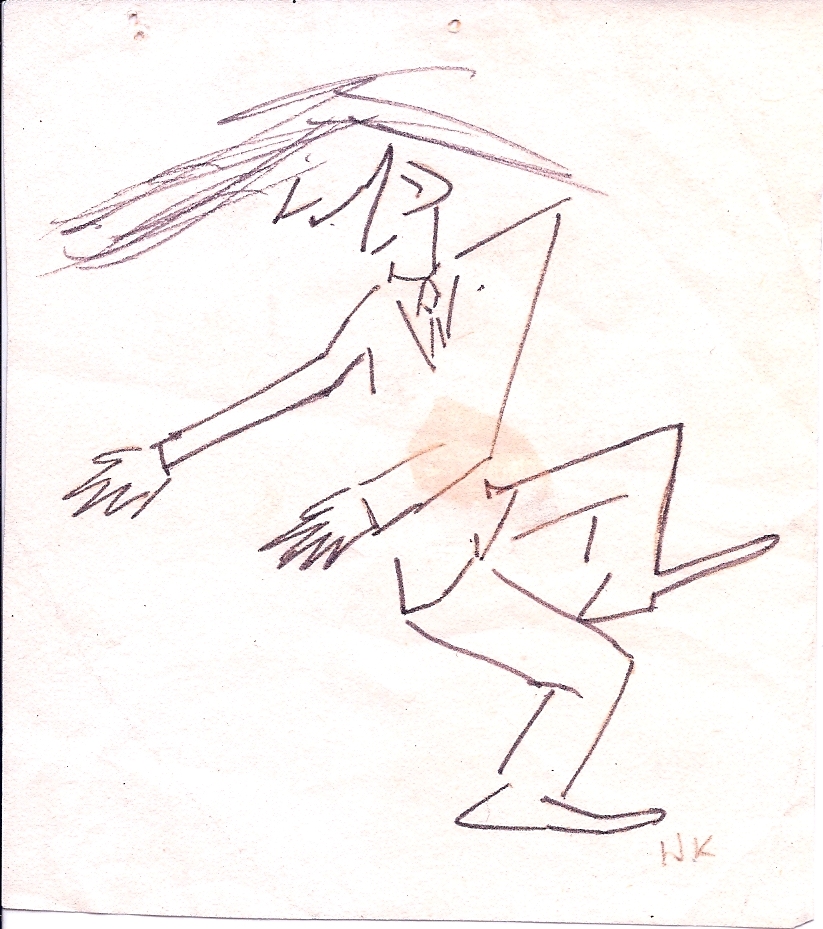
What’s striking to me is that in a few words, Kerouac is able to capture something essential about the music — even if he misses much of its subtext. For Sal — for Kerouac — the music offers a religious experience, a la the 12th century Sufi monks, the whirling dervishes who vow poverty and spin and dance in ecstatic rituals. The Beats — a designation applied well after the events of On the Road — saw work and money as necessary only insofar as it allowed them to chase ecstasy. Money filled the gas tank, paid the rent, kept the whiskey flowing and the tea rolled into joints. When money wasn’t available, the quest for enlightenment through kicks permitted them to beg, borrow and steal what was needed. Jazz was part of this chase, as a Sal makes clear in his description of New Year’s weekend performance by George Shearing.
Shearing came out, blind, led by the hand to his keyboard. He was a distinguished looking Englishman with a stiff white collar, slightly beefy, blond, with a delicate English-summer’s-night air about him that came out in the first rippling sweet number he played as the bass-player leaned to him reverently and thrummed the beat. The drummer, Denzil Best, sat motionless except for his wrists snapping the brushes.
It’s all very quiet. Reverent. Then Shearing begins rocking — people are always rocking in Kerouac’s prose, as if they are davaning, lost in prayer. He starts slowly until “the beat went up”
and he began rocking fast, his left foot jumped up with every beat, his neck began to rock crookedly, he brought his face down to the keys, he pushed his hair back, his combed hair dissolved, he began to sweat. The music picked up. The bass-player hunched over and socked it in, faster and faster, it seemed faster and faster, that’s all.
Kerouac’ prose gains its own momentum, the clauses shrink in length, coming in quick bursts like Shearing’s chords, which “rolled out of the piano in great rich showers, you’d think the man wouldn’t have time to line them up.”
As they “rolled and rolled like the sea,” the crowd revs up. Dean, sweating, shouts “There he is! That’s him! Old God! Old God Shearing! Yes! Yes! Yes!” Ecstasy unleashed. The music, the tea, madness that “would lead nowhere,” and yet, “everything was about to arrive — the moment when you know all and everything is decided forever” (128-129).
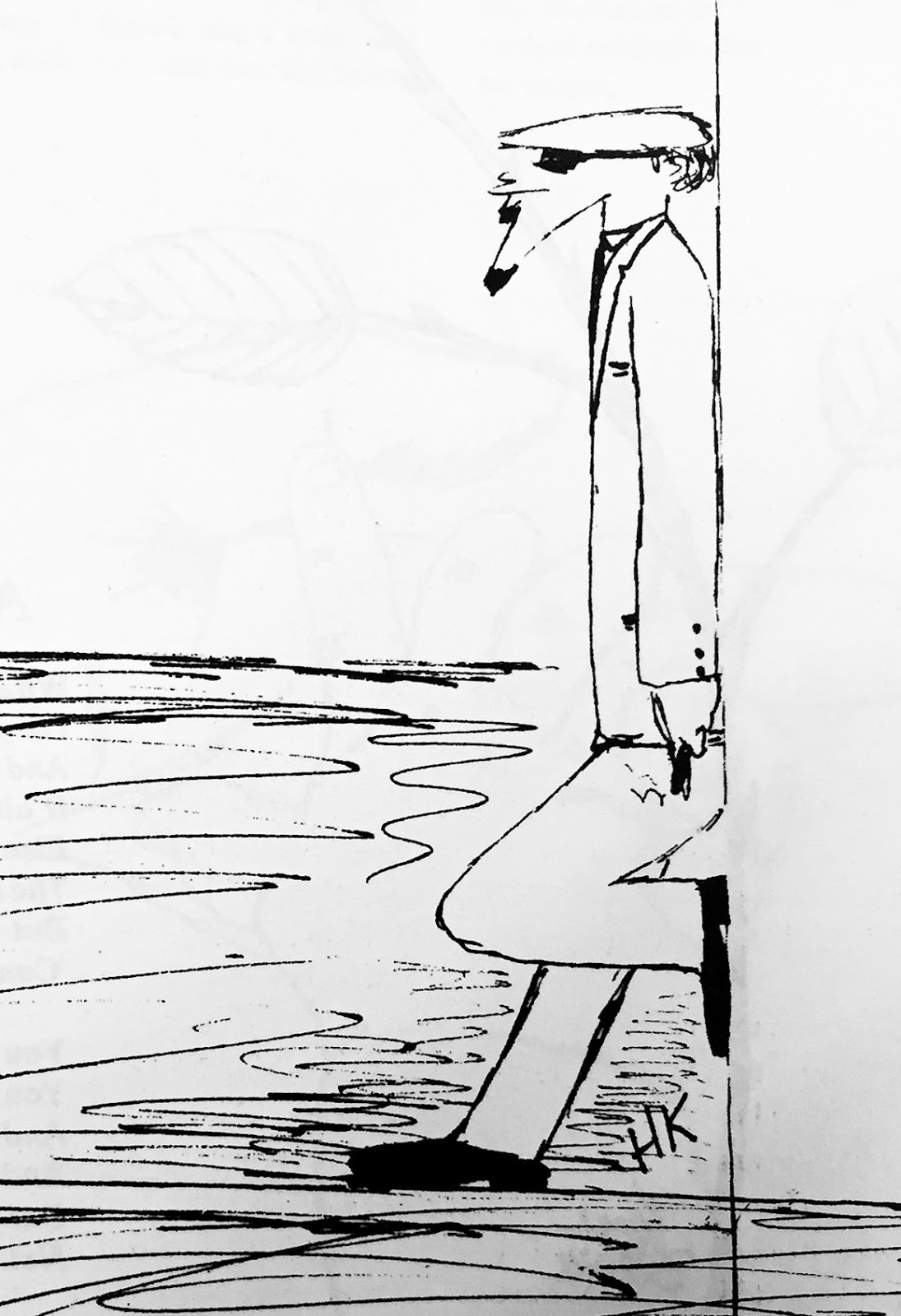 |
| A drawing from the mid-’80s. |
These passages offer Kerouac both at his best and worst, injecting the essential energy into his text, while also remaining innocent to the deeper political implications of the music. As Douglas Malcolm writes in “Jazz and African American Culture in On the Road,” Kerouac distills the music down to its individual stars, which is consistent with the Beat ethos of individual enlightenment.
Kerouac’ focus is on soloists, or musicians who derive their fame from their ability to rise up above the collective. This focus ignores the importance of band leaders and composers like Duke Ellington, whose “genius manifested itself collectively in his bands rather than as an individual performer.”
The characteristic which in Kerouac’s mind unites the historic musicians above all is their “madness”; the unavoidable implication is that he music derives not from rational thought but from visceral spontaneity. Hence Louis Armstrong springs like Adam from the “muds of New Orleans” and literally erupts playing with the “mad musicians” is hometown. Roy Eldridge’s music, although suggestive of “logic,” comes in “waves of power.” Charlie Parker was “flipped” out of his mind, and Lester Young is depicted as “the saintly goof” (Malcolm 102).
This is typical of a broader racial issue in the book, one tied to the old “noble savage” trope that has long hampered discussion of race and that has left much ethnographic study mired in stereotypes. Kerouac treats African Americans as a type — Mexicans, too, and the somewhat murky term fedaheen that he uses as an all-purpose moniker for the darker people of the world. He romanticizes them, assumes them simple and closer to the earth and god. An “old Negro couple” is described as picking cotton in California “with the same God-blessed patience their grandfathers had practiced in ante-bellum Alabama” (96), as an absurd and ahistorical observation as one can make (Malcolm cites a James Baldwin essay that criticizes the passage). Comments like this can be found through out, but they are especially noticeable when he writes about jazz.
He describes a night in San Francisco at a little “sawdust saloon” in the “little Harlem on Folsom Street.” A small combo was playing, led by a “wild tenorman” with a “bawling horn.”
The behatted tenorman was blowing at the peak of a wonderfully satisfactory free idea, a rising and falling riff that went from “EE-yah!” to a crazier “EE-de-Lee-yah!” and blasted along to the rolling crash of butt-scarred drums hammered by a big brutal Negro with a bull neck who didn’t give a damn about anything but punishing his busted tubs, crash, rattle-ti-boom, crash. (196-197)
This goes on for several pages, the music pushing the crowd to fervor, Sal and Dean and the crew in ecstasy, and the musicians pressing forward. It is describes as purely in the moment, just a set of free ideas blasted into the firmament, each individual pursuing his own sonic dynamite. No thought given to, no recognition of the tireless work out in before the players hit the stage — the composition and arrangement work, the rehearsals that allow each man to play off the other, the riffs tried and abandoned in the writing and arranging process, the plan hat is put in place before show starts. It just happens. The players are pure and operate on a direct line creator.
This ignores both the history of the music and the deep intellectual seams from which the musical ideas are mined. No one can listen to Thelonious Monk or Charles Mingus and not hear the purpose behind every note and brushstroke, every solo and every riff.
I was listening first to Roy Eldridge and then to Coleman Hawkins with Eldridge as I wrote this. The Eldridge orchestra of the late-40s could truly swing. Eldridge’s trumpet is the driving force for much of what you hear on the records, but Bill Rowland’s work on the ivories, both as part of the rhythm section setting the foundation for the horns to blow, and then when his piano moves to the forefront, is riveting. The playing, composition and arrangement force you to hear both the unit in action and its individual parts. It resonates emotionally and intellectually. It is not accidental.
The Hawkins/Eldridge performance, recorded and originally released in 1957, can be heard as a duel, a prizefight between heavyweights, which would play into the individualist narrative Kerouac uses in describing jazz. And it’s not incorrect, though it is better heard as a dialogue between Hawkins sax and Eldridge’s trumpet, and a broader conversation among all players on the stage. Hawkins and Eldridge are the loudest, but by no means are they the most important players.
I often liken jazz to basketball, which can seem chaotic to the naked eye and driven solely by its stars. But at its best, the game mixes improvisation with a plan and even the best players — Michael Jordan, Lebron James, Magic Johnson, Wilt Chamberlain — are only as good as their sidemen, only as good as the system (i.e., the arrangement). Lebron can improvise and win because the structure is solid, the plan is well thought out, and everyone is one the same page.
Hawkins can dive into a blistering solo only if his sidemen have laid the foundation. It is a team effort, and the spontaneity is choreographed, not each note but the framework in which each note is played.
One other thing: Reading Kerouac on jazz today reminds us that, as a music, it is more vibrant and potentially revelatory than the staid concert hall jazz or easy listening instrumentals that the word conjures for many. It’s sweaty and dynamic and full of life. Turning it into chamber music is bad for the art form and not at all true to its origin. Kerouac gets it, even if he has created its own false mythology in the process.

 Hank Kalet