
I thought I was a beat, but I was just a boy
Notes on Re-Reading Kerouac in my 50s
 |
| Kerouac’s hand-drawn map, posted from Pinterest (https://www.pinterest.com/pin/275845545900879627/) |
I’m looking backward.
Jim had a convertible, a classic Camaro. It was a spring day, early spring. He took it out, Joe and I along for a the ride. And what a ride. Tooling around the farm roads and highways that circled the State College campus, top down, Joe and I stoned, taking turns standing and leaning into the wind. It was crazy, but the breeze was bracing. I felt like Sal. I’d just read the book, first time. Not yet 19, riding in the open air.
Several days later, Jim taxis us out to Route 80. Joe and I, back packs filled with a couple days of clothes, my notebooks tucked in with a couple of books, and such. We were heading east to spend the weekend at my house in Jersey and we were going to thumb it.
The goal on its face was Jersey, a four-plus-hour drive, but deep down I envisioned Kerouacian adventures. A disastrous first year at Penn State was coming to a close, and a summer working in a Trenton factory loomed — along with an array of concerts and a chance to hang with he guys. I needed it, I bought, a chance to put the miserable class work behind, to reconnect. School had started off well — I got A’s and B’s — but quickly saw my GPA crater. Class and class work ceased to be important. I was writing for the first time — not the journalism I did in high school, but terrible poetry and short stories. I was spending more and more time at the radio station, and bumming around State College’s record stores and head shops.
I had self-consciously gone bohemian, without really understanding what that meant, which is when I read On the Road for the first time. Something clicked, something about the book helped explain a disconnect I was feeling more and more regarding who I thought I was in high school.
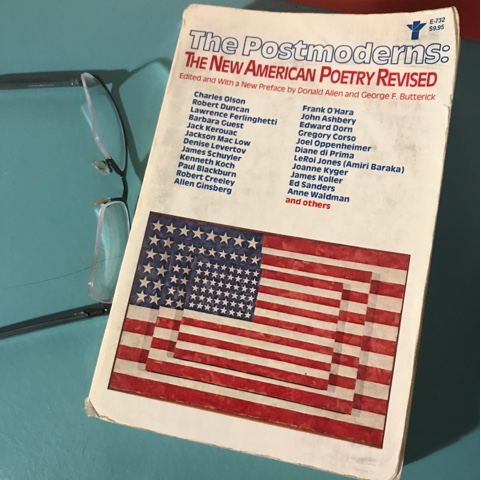 It’s too easy to say On the Road expanded my mind. It didn’t, though I think it’s fair to say it was part of a bigger intellectual awakening that included not only the Beats and an immersion in jazz, but books by Hemingway, Sherwood Anderson, the French poets (of which I feigned an understanding), Sartre and Camus, and a poetry anthology called The Postmoderns: The New American Poetry Revised that I still own and still read.
On the Road, however, did leave me with a romantic impression of the open road, which led me to suggest to Joe that we hitchhike. And the book, I think, colors my impressions of that day, which must have featured a lot of walking, a few rides, and much conversation. I honestly remember little of it, aside from two rides: One was a priest that, in my mind, has become a Russian Orthodox priest with a big beard and booming voice who told us of his congregation and his thoughts on he promiscuity of the younger generation. I want to write “great Russian priest” in the Kerouacian manner, implying a thick accent outline Boris and Natasha from of Rocky and Bullwinkle, but that seems unlikely, and in any case I remember little else from that ride. The other ride was from a hippie couple in a pickup. The let us ride in the bed in the open air with their German shepherd Cocaine, who had a Zen-like calm that neither Joe or I could muster. It was obvious the dog had ridden back their before, while the two of us were subjected to the wind ripping past as the truck burned east on Route 80 probably doing 80-plus. I remember us being exhilarated by the ride, and I’m sure that’s true, but memory is a tricky thing, especially 35-plus years later.
We hitched back, against my dad’s demands. He did drive us up to the Water Gap, which gave us a head start. The return trip was uneventful until we got off Route 80 near Penn State. Traffic died down and we did a lot of walking. It was growing dark. I walked and played harmonica, probably the one or two blues riffs I knew. I wasn’t very good, and I suspect that Joe was annoyed, but he never said a word. We eventually got a ride and made it back to the dorms, adventure over.
I hitched that route several times after, and also hitched South to the West Virginia University with a girl named Eileen. She was just a friend, but like me infatuated with the Beat/hippie ethos. Our friend Rusty and another girl (I don’t remember her name, though she and Rusty ended up a couple after our trip) also made the trip, racing us down by a different route.
I don’t remember much about the trip except that Morgantown was in the West Virginia mountains, was unbelievably hilly and the streets were lined with older houses. There were parties and a girl and the weekend was a blur and I felt as though I were inside On the Road, running around Central City in a manic state. It was all very romantic and so long ago.
I soon left school, carrying a 1.7 GPA, with few prospects, assuming I’d write my way to riches. Young and dumb and mostly too stoned to realize it. I thought I would find enlightenment through the holy grail of “kicks,” but I was wrong. Enlightenment is elusive and I’m not sure it’s truly obtainable. What I do know now is that we only come close to realizing a personal nirvana, to borrow the Buddhist term, through human connection and deep commitment. I only learned that by experiencing it, by finding ways to keep love’s flame burning across multiple decades, through challenges both big and small.
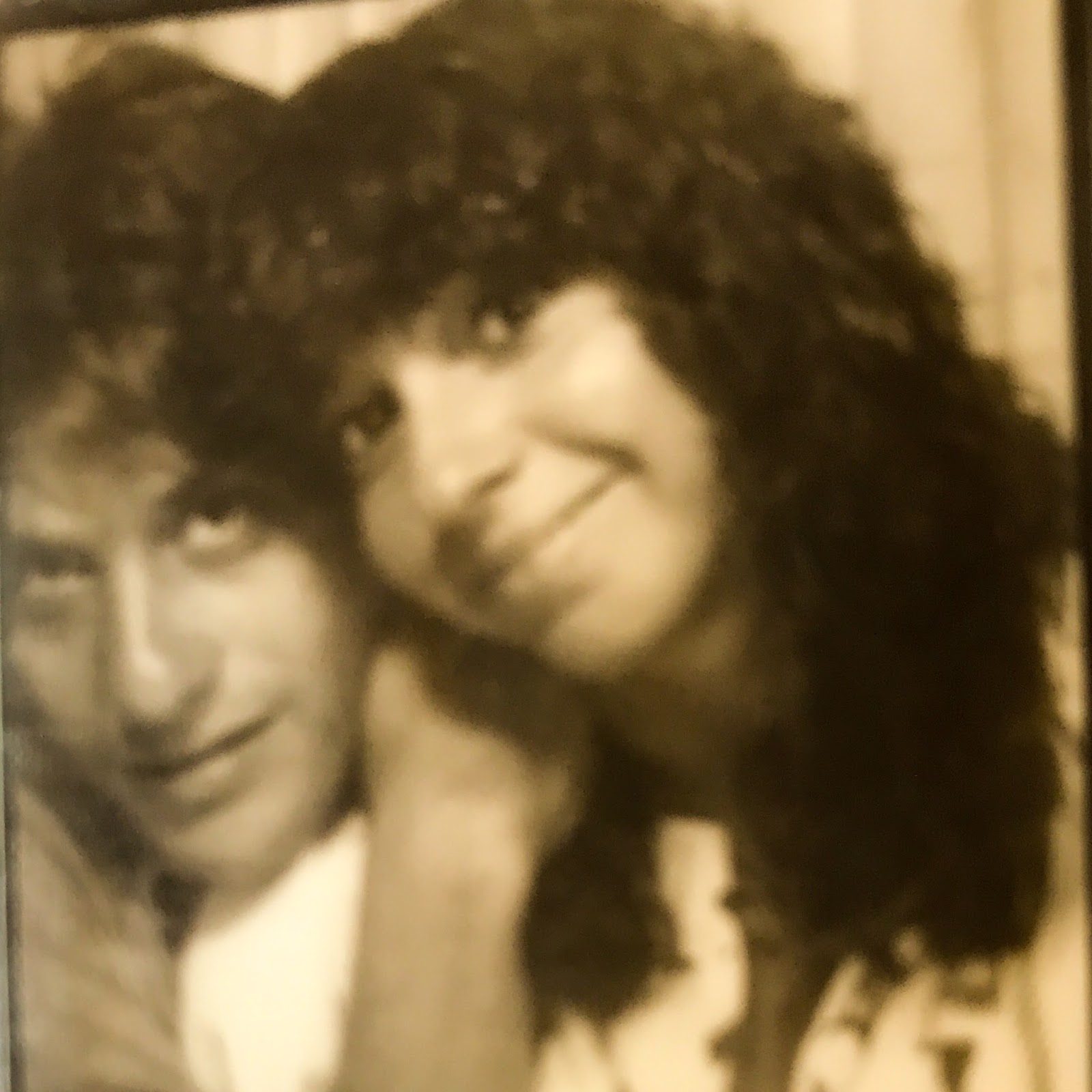 |
| Annie and I, circa 1982. |
It’s not that Annie and I are one, that our lives are perfect. We are not and our lives are not. We are individuals who are better together than apart, who are better able to battle through life’s imperfections together.
Sal has trouble seeing this in On the Road — or maybe it’s not that he can’t see it, but that his vision of nirvana involves seeking an ideal that is inconsistent with his tortured combination of hedonism and asceticism.

 Hank Kalet