
I thought I was a beat, but I was just a boy
Notes on Re-Reading Kerouac in my 50s
Part 2 (Read Part 1 here.)
Let’s talk about the mad ones.
Kerouac, in what is probably the book’s most famous passage, writes that he “shambled after” Marx and Moriarty
as I’ve been doing all my life after people who interest me, because the only people for me are the mad ones, the ones who are mad to live, to talk, mad to be saved, desirous of everything at the same time, the ones who never yawn, or say a commonplace thing, but burn, burn, burn like fabulous yellow roman candles exploding like spiders across the stars and in the middle you see the blue centerlight pop and everybody goes “Awww!” (Kerouac 8)
The thrill of his writing, when he is on, is here in the passage. It’s built on a seemingly endless run of prepositional phrases that heighten the extremes of emotion with which he often is overcome. It presages the ’60s in its implicit critique of normative society, while also hinting at the shortcomings of the hedonist philosophy that drove the decade into excess and solipsism.
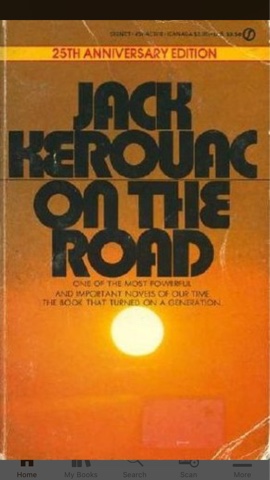 |
|
| The cover of my 1st edition. |
It’s important to keep in mind the placement of this passage, early in the book, before Sal heads out on his various adventures, finds exhilaration and disappointment, before the weight of it all settles on his shoulders. I think it’s fair to ask why this passage remains the one most people remember and quote. The answer is two-fold, I think: First, it is consistent with the mythology that surrounds the book; second, it stands, even after 300-plus pages, as Kerouac’s theme, that one must seek the extreme even as the narrator is always a step behind, always finding his thrills, his joys, to be temporary. To “burn, burn, burn like fabulous yellow roman candles exploding like spiders across the stars” is also to burn out spectacularly. “Live fast, die young, have a good looking corpse,” as the mobster in Knock on Any Door says.
This ethos, though, is limiting. James Dean. Janis Joplin. Kurt Cobain. All died too soon, robbing us of the kind of art they might have grown into. “Grow old along with me / The best is yet to be,” as Browning writes.
On the Road aggrandizes youth and motion, but also traffics in a kind of nostalgic mythology. It is critical both implicitly and explicitly of the adult and what might be called the square world, yet somehow viewing certain mythologized traditions as noble or worth preserving.
Consider his short stay in Cheyenne — again, early in the book. He and his crew of beatified hobos arrives in the Wyoming capital during Wild West Days, when the old town section of the city is remade into an old-fashioned western town from the movies. Sal is bemused and dismissive. He gets the economic imperative — towns using a mythologized representation of their history to attract visitors — but he finds the whole thing ridiculous and his critique is framed with a physical stereotype: “Big crowds of businessmen, fat businessmen in boots and ten-gallon hats, with their hefty wives in cowgirl attire, bustled and whooped on the wooden sidewalks of Old Cheyenne” (33). This is a kind of cartoon essentialism that robs the people he targets of depth, transforms them into the broadest of stereotypes — something he does through out the book with African Americans, Mexican, workers, the poor, etc.
It’s an attitude that animated elements of ’60s youth culture — and which was critiqued in dystopic films like Wild in the Streets and Logan’s Run, films that presented a vision of youth power run amok.
And yet, Sal is not entirely off base. The Cheyenne event glorifies the past. Its nostalgiac take on “The Wild West” is about money, first, but also about looking backward and, as such, it presages much of our political dysfunction. The Trump phenomenon is about looking backward, is built on the kind of narrative gymnastics we’ve performed in creating the story of American exceptionalism. The past offers respite from the present, seems better, and may be for some. But for others, those excluded from the mythic narrative, the past is better left in the past. Nostalgia, as a political mode, is reactionary and potentially dangerous. Sal, in Cheyenne and throughout the book, is caught between his urge to make it new, to avoid the commonplace, and his tendency to lionize certain traditions, to look backward himself.

 Hank Kalet