
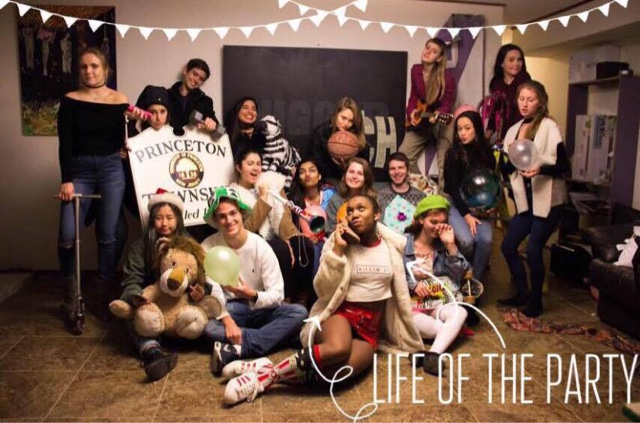
 |
| Yearbook photo courtesy of Planet Princeton |
I’ll let this report from my friend Krystal Knapp’s hyperlocal Planet Princeton set the scene:
Jamaica Ponder, the high school senior who has chronicled racist incidents in Princeton over the last year on her blog, has been suspended because of a photo she submitted to the yearbook that was then published.
Ponder was suspended for using “explicitly racial language,” in her senior collage photo. The photo in question included two pieces of artwork in the background from her father’s art exhibit “The Rise and Fail of The N-Word.”
Apparently, at least one other student was suspended for a similar offense — the manipulating of photos of North Korea and Nazi Germany (students’ heads were placed on the bodies of marchers). Students, in comments posted to Planet Princeton, have made the case that the photos are symbolic speech, that the images are meant to critique a culture of racism and elitism at Princeton High School — a contention I don’t want to debate. I don’t have any direct knowledge, nothing more than what I’ve read on Planet Princeton and elsewhere. I will leave discussion of the school’s culture to the students and administrators there, to the local press, and to parents.
What I will say, however, is that the paintings that have caused the uproar are artistic critiques of American racism. Rhinold Ponder, Jamaica’s father, told Planet Princeton
The purpose of the imagery is to promote racial literacy and dialogue, he said. “It’s difficult in our society to talk about race, and everyone is so stifled by a word,” he said, noting that teens who visit the Ponder home often ask about the art, which leads to thought-provoking discussions about race.
One painting called “Strange Fruit: High Tech Lynching” shows Michael Jackson, O.J. Simpson and Clarence Thomas hanging from trees with televisions around their heads across from an image of a lynching victim. A second painting is the words “NIGGER RICH,” in dark acrylic paint and chopped up dollar bills.
The two paintings are obscured in the yearbook photo (see above), but even if they weren’t they are symbolic speech deserving of more respect and consideration than a school zero-tolerance policy on racial language can apparently allow.
Some want to make this an equity issue — a white kid likely would have been suspended for a similar offense, they say, and that may be the case. But the use of this kind of imagery and language by a white student or white painter is likely to create a very different set of meanings.
As I wrote back in March about a Whitney exhibit that included a painting by a white artist of a famous photo of a dead Emmett Till in his casket, the context in which a work of art is created or language is spoken can be as important as the work itself. Questions of appropriation get raised — who has the right to tell the story, to benefit from the story, can a particular ethnic group own its history or is it broader than that — and the meaning of the language and the images is affected by the context.
Consider the Emmett Till painting. Dana Schutz painted it and, after the uproar surrounding its exhibition, offered this statement:
“I don’t know what it is like to be black in America but I do know what it is like to be a mother. Emmett was Mamie Till’s only son. The thought of anything happening to your child is beyond comprehension. Their pain is your pain. My engagement with this image was through empathy with his mother.” She added: “Art can be a space for empathy, a vehicle for connection. I don’t believe that people can ever really know what it is like to be someone else (I will never know the fear that black parents may have) but neither are we all completely unknowable.”
For the white viewer, this explanation might resonate. But it is reductive. It deracinates the image — Schutz attempts to universalize something that is far from universal, something that is connected to hundreds of years of history, hundreds of years of persecution of Africans and African Americans who continue to be judged, even killed, because of the color of their skin. Till in his coffin will always be a powerful image, but its power derives from its history and the history of a people.
I don’t want to rehash the Till debate — I am somewhat ambivalent about this, because I’m opposed in general to limitations being placed on artists while at the same time understanding the various ways in which privilege influences our understanding of art and our relationship to the tellers of history’s stories.
This is the context in which paintings like these should be judged. “Strange Fruit,” for instance, takes its title from a song made famous by Billie Holiday, but written by a Jewish songwriter, and symbolizes how powerful African Americans are treated by the American news media. It is artistic and symbolic speech that uses imagery and language that, in other contexts, would be offensive.
Context, however, when zero-tolerance is the policy in place. Don’t get me wrong, schools need to crack down on racism within their walls and on their playing fields. But zero-tolerance leaves no room for consideration of context or mitigating factors. In many ways, zero-tolerance policies are designed to protect administrators as much as students.
I also question whether the school administration is even interested in questions of context. Principal Gary Snyder sent out a message to parents that described the images as “insensitive, offensive, and provocative words and symbols of racial bias, bigotry, and anti-Semitism.” There is a difference between using images to critique a school’s culture or to underscore the impact of white privilege and white supremacy, and students using Holocaust imagery — playing Nazi-beer pong — to spice up a drinking game. I suspect the administration knows that that.

 Hank Kalet
I agree wholeheartedly Mr. Kalet. http://freestateofponder.com/index.php/2017/06/15/nigger-rich-and-the-hypothetical-white-boy-standard/ Please feel free to visit my site and leave your article as a comment.