
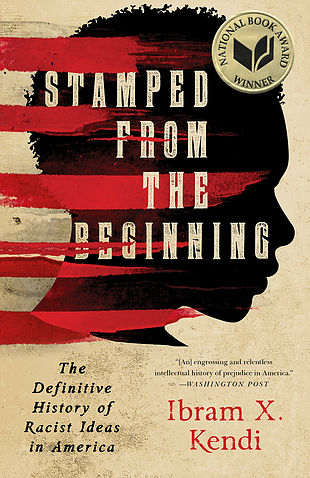
I’m reading Stamped from the Beginning: The Definitive History of Racist Ideas in America by Ibram X. Kendi, an important look at the birth and continuance of sometimes overt and sometimes unconscious racist thought. I was struck by this long passage (pp. 124-125), which echoes the arguments made by people like Randall Kennedy, Barack Obama and Bill Cosby over the years:
As freed Blacks proliferated in the 1790s and the number of enslaved Blacks began to decline in the North, the racial discourse shifted from teh problems of enslavement to the condition and capabilities of free Blacks. The American Convention (for promoting the Abolition of Slavery and Improving Conditions of the African Race) delegates believed that the future advance of abolitionism depended on how Black people used their freedom.
That meant, Kendi writes, advocating “uplift suasion” and pushing blacks to
attend church regularly, acquire English literacy, learn math, adopt trades, avoid vice, legally marry and maintain marriages, evade lawsuits, avoid expensive delights, abstain from noisy and disorderly conduct, always act in a civil and respectable manner, and develop habits of industry, sobriety, and frugality.
There is nothing wrong with any of these behaviors, in general, but the advice tracts published by the American Convention and targeted to free blacks, Kendi writes, meant that the “burden of race relations was placed squarely on the shoulders of Black Americans.”
If Black people behaved admirably, abolitionists reasoned, they would be undermining justifications for slavery and proving that notions of their inferiority were wrong.
Kendi’s book creates a taxonomy of America’s view of racial views, separating then into three basic categories: the segregationist/overt racist; the assimilationist racist; and the anti-racist.
The segregationist, he writes, views “Black people as biologically distinct and inferior to White people.” Blacks skin, for them, is an “ugly stamp on the beautiful White canvas of normal human skin” (p. 3).
The assimilationist, he writes, may seem to be an anti-racist, fighting to end slavery and segregation, but still fostered racist ideas.
In embracing biological racial equality, assimilationists point to environment — hot climates, discrimination, culture, and poverty — as the creators of inferior Black behaviors. For solutions, they maintain that the ugly Black stamp can be erased — that inferior Black behaviors ca be developed, given the proper environment. As such, assimilationists constantly encourage Black adoption of White cultural traits and/or physical ideals.
Kendi’s argument is simple: The creation of this kind of racial hierarchy, whatever its provenance, is racist. To say that blacks, for whatever reason are inferior, or that their behavior as a group is inferior, is racist. He is not saying that crime and poverty in black-majority neighborhoods does not exist, or that slavery and segregation, police brutality and de-industrialization have not taken their toll. On the contrary. He would agree that they have. What he is saying, however, is “there is nothing wrong with Black people as a group (italics in original), with any other racial group” (p. 11).
All cultures, in all their behavioral differences, are on the same level. Black Americans’ history of oppression has made Black opportunities — not Black people — inferior.
But what does this have to do with Kennedy, Obama and Cosby? He doesn’t directly address the “respectability” argument — at least not through the book’s first 120 pages — but he does point the finger at himself.
We have a hard time recognizing that racial discrimination is the sole cause of racial disparities in this country and in the world at large. I write we for a reason. When I began this book, with a heavy heart for Trayvon Martin and Rekia Boyd, I must confess that I held quite a few racist ideas. Even though I am an Africana studies historian and have been tutored all my life in egalitarian spaces, I held racist notions of Black inferiority before researching and writing this book.
Being an African American, he says, did not insulate him from an internalized racism. “Racist ideas are ideas” and
Anyone — Whites, Latina/os, Blacks, Asians, Native Americans — anyone can express the diea that Black people are inferior, that something is wrong with Black people.
There is a strain within black thought and in progressive thought more generally that essentializes race, that uses cultural reasons to explain so-called toxic or allegedly pathological behaviors among blacks (this could be anything from actual street violence that does real harm to individuals and communities to rather benign behaviors like the wearing of saggy jeans or the use of unacceptable slang or pronunciations) and tie the behavior of some to blacks as a racial group. This is not Jim Crow racial geneticism, but it creates the same kinds of racial hierarchies in the culture.
So when the nation’s first black president ignoring racial issues for much of his eight years in office except when he is hectoring a black audience and lecturing black youth for their saggy pants he fosters the mythology of black inferiority. While not letting the segregationists off the hook — yes, they still exist and still exert a dangerous level of influence on policy — Obama points the fingers at black culture, sharing the blame and, ultimately, making it the responsibility of black America to end discrimination and racism. This is the “uplift suasion” argument brought into the present. The
strategy to undermine racist ideas was actually based on a racist idea: “negative” Black behavior, said that idea, was partially or totally responsible for the existence and persistence of racist ideas. To believe that hte negative ways of Black people were responsible for racist ideas was to believe that there was some truth in notions of Black inferiority. To believe that there was some truth in notions of Black inferiority was to hold racist ideas.
I know this puts me out on a limb — a middle-class, white Jew pronouncing on the racial views of middle-class blacks is incredibly problematic and I apologize if I seem presumptuous. And I know I am far from pure on this issue. I am guilty of making the same kinds of arguments in the past that I am criticizing today, falling prey to the logical fallacy of generalizing, of turning behaviors that are more properly tied to a paucity of opportunity into pathologies and a ascribing them to “the black community” as if it is a monolith. My motivations were decidedly progressive — removing barriers to opportunity and ending segregation and discrimination — but my thinking and language relied on an underlying assimilationist approach.
My underlying racist — and those of most progressives who carry them — notions do not stem from any animus on my part, but are the outgrowth of hundreds of years of history in which the dominant powers cast blacks in the role of inferior beings. Recognizing this is important. I think this is why the word “woke” and its modern definition is so perfect for our times. Most of us have acknowledged the role race has played in our society, but many have yet to examine their own buried (and, for some, not so buried) racist beliefs. That examination, seeing how it governs our thinking, our language, our policies — seeing it, recognizing it for what is is, and then working to change this dynamic — that is what it means to be “woke.”

 Hank Kalet