
Congress shall make no law respecting an establishment of religion, or prohibiting the free exercise thereof; or abridging the freedom of speech, or of the press; or the right of the people peaceably to assemble, and to petition the government for a redress of grievances.

Protest is as American as apple pie. We are a nation formed through protest, that has enshrined the right of assembly and petition in the constitution. But we also are a people who prize order. The standard response to protesters — especially from supporters of Donald Trump — is that they are whiners, sore-losers and malcontents, even that they are dangerous.
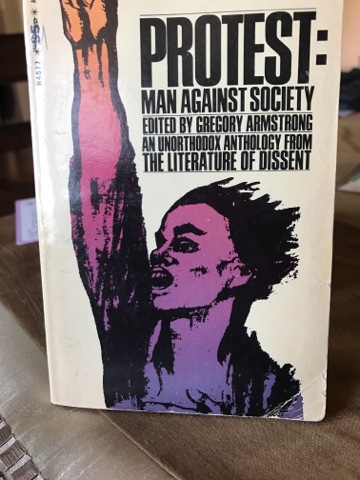 I’ve written about some of the conversations I’ve had with friends and acquaintances, live and on Facebook, conversations in which I have had to defend what I consider an indelible American right. Presenting the issue this way can be problematic — relying on stray comments and individual discussions makes the evidence seem suspect and opens me up to charges of creating a straw man argument. But the antipathy to protest is real and it is now taking forms that could have a deleterious impact on our democracy.
As The New York Times reports today, at least a dozen states are considering legislation that would criminalize protest, subject protesters to excessive civil penalties, or indemnify those whose actions in response to protesters ultimately lead to injury — efforts that are designed specifically to quiet citizens who seek to push back against their government.
Defenders of these efforts have been making what sound like reasonable arguments about safety, about access. But in most places, the laws already allow police to arrest protesters who create hazardous conditions, either for themselves or the public at large. The motivations, then, appear to go beyond that — and that’s where this becomes a constitutional threat.
“There are already laws on the books in states that say if you break something or harm somebody, you’re going to be prosecuted,” said Patrick F. Gillham, a sociologist at Western Washington University who studies protests. “They’re troubling. They potentially have a chilling effect on protest.”
The laws target something that is endemic to successful protest actions — the need to inconvenience people, to create tension, to wake people from their slumber. Creating tension is a primary goal of protest, as the Rev. Dr. Martin Luther King Jr. wrote in “Letter from Birmingham Jail.” Direct action — sit ins, marches, rallies are not ends in themselves, but a means to move the culture, the society.
Nonviolent direct action seeks to create such a crisis and foster such a tension that a community which has constantly refused to negotiate is forced to confront the issue. It seeks so to dramatize the issue that it can no longer be ignored. My citing the creation of tension as part of the work of the nonviolent resister may sound rather shocking. But I must confess that I am not afraid of the word “tension.” I have earnestly opposed violent tension, but there is a type of constructive, nonviolent tension which is necessary for growth. Just as Socrates felt that it was necessary to create a tension in the mind so that individuals could rise from the bondage of myths and half truths to the unfettered realm of creative analysis and objective appraisal, so must we see the need for nonviolent gadflies to create the kind of tension in society that will help men rise from the dark depths of prejudice and racism to the majestic heights of understanding and brotherhood. The purpose of our direct action program is to create a situation so crisis packed that it will inevitably open the door to negotiation.

Critics called King and civil rights protesters extremists — a description he found honorable. The extremist, he said, is willing to put his body on the line for justice. The question, he said, “is not whether we will be extremists, but what kind of extremists we will be.”
Will we be extremists for hate or for love? Will we be extremists for the preservation of injustice or for the extension of justice? In that dramatic scene on Calvary’s hill three men were crucified. We must never forget that all three were crucified for the same crime–the crime of extremism. Two were extremists for immorality, and thus fell below their environment. The other, Jesus Christ, was an extremist for love, truth and goodness, and thereby rose above his environment. Perhaps the South, the nation and the world are in dire need of creative extremists.
King’s language might surprise some — given the “whitening” his image has undergone in recent years. By this I mean the efforts to make him palatable, easy to digest, to recast him as a colorblind exemplar of American equality. We quote the “content of their character” line, but we ignore his calls for justice, his demand for freedom, for liberty, for the nation to make good on its own “promissory note.” It wasn’t Dr. King who asked “can’t we all just get along?” That was Rodney King and that question arose from the flashpoint of the LA riots — when a group of police officers were exonerated after being captured on tape beating King.
The LA riots occurred 26 years ago. The national debate that followed, however, drew the wrong conclusions — a ramping up of the war on drugs and get-tough policing, while only paying lip service to the actions of law enforcement. We have witnessed a massive expansion of the U.S. prison population, a militarization of police forces, quality-of-life policing — and, finally, the kind of explosive response within the community that Dr. King predicted.
I asked my students last week (as we began preparation for their research paper on power and responsibility) how they though King — along with Erich Fromm and Henry David Thoreau — might respond to today’s protest movements. The answers were telling. King, they said, would be aghast. He’d be opposed to what is happening.
“You don’t think he’d be out there leading the protests,” I asked.
“No,” was the nearly unanimous response.
We can’t know, of course, but the evidence does offer us some idea. King sided always with the oppressed. He may have abhorred violence, but he also understood its provenance. “Oppressed people cannot remain oppressed forever,” he wrote in “Letter.” “The yearning for freedom eventually manifests itself.” And the “many pent up resentments and latent frustrations” need to be released. The demands must be heard.
So let him march; let him make prayer pilgrimages to the city hall; let him go on freedom rides — and try to understand why he must do so. If his repressed emotions are not released in nonviolent ways, they will seek expression through violence; this is not a threat but a fact of history. So I have not said to my people: “Get rid of your discontent.” Rather, I have tried to say that this normal and healthy discontent can be channeled into the creative outlet of nonviolent direct action.
 So, yes, he condemns violence as immoral, but also makes it clear that it remains close to the surface, that it can burst forth at anytime if justice is not service, if the oppressed are not given real hope.
Laws criminalizing protest, therefore, are both antithetical to our constitutional values and counterproductive. Remember, King was writing from the Birmingham jail after being arrested on charges that he failed to get a parade permit for a march — a permit the protesters sought and were refused. The law, the broader intent of which King did not question, was used as a tool of oppression in this case and that made it unjust.
The laws being proposed today may on their surface seem benign. But like the parade permitting law in Birmingham in the early 1960s, they are not. Their application is designed to restrict protest, to chill speech, and that makes them an unjust use of state power.
Send me an e-mail.

 Hank Kalet