
 |
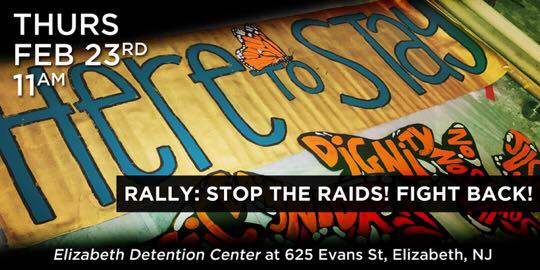
| From the Make the Road New Jersey Facebook page. |
The opposition is not staying quiet.
Congressional town halls around the country have become lightning rods for protest — the latest example being the massive crowd that targeted U.S. Rep. Leonard Lance (R-Somerset) last night during his town hall meeting at Raritan Valley Community College. NJ.com reported that
The 900-seat theater at the college was filled and another 400 people sat in a nearby overflow room. It was the biggest crowd Lance has drawn. Besides those inside, hundreds of demonstrators equipped with signs and slogans gathered outside long before the town hall began.
And they were not quiet.
Lance was heckled when he talked about the need to make changes to the health care law, booed when he supported taking federal funding away from Planned Parenthood, and drowned out by catcalls when he refused to back Rep. Bill Pascrell Jr.’s effort to force Trump to release his income tax returns.
Most of the town halls have focused on GOP efforts to roll back the Affordable Care Act — mirroring the town hall protests that met Democrats eight years ago when the law was first passed. These protests, however, are larger and they are part of a much broader opposition movement designed to push back against the agenda of President Donald Trump — especially his hard-line efforts on immigration.
Trump’s Department of Homeland Secuity issued a series of directives Tuesday designed to enforce the Jan. 26 executive order issued by the president that called for stepped up enforcement actions and an expansion of local involvement. The directives, as reported by The New York Times, translated”Trump’s executive orders on immigration and border security into policy, bringing a major shift in the way the agency enforces the nation’s immigration laws.” They included
- a broader definition of which immigrants are viewed as priorities for deportation, achieved by redefining what constitutes significant criminal activity;
- an expansion of expedited removals to include the entire country and not just the border region;
- the hiring of new enforcement agents — the estimates are as many as 10,000, and there have been rumors of a National Guard call-up;
- and the recruiting of “local police officers and sheriff’s deputies to help with deportation, effectively making them de facto immigration agents.”
Enter groups like Make the Road New Jersey, the American Friends Service Committee, Faith in New Jersey and others. The groups have been advocating on behalf of immigrants for years, including through the increased deportations of the Obama presidency, and they are preparing to resist — including taking to the streets.
A rally is planned for today at 11 a.m. in Elizabeth to show support for immigrants and to send a message to Washington that they do not plan to sit quietly.
As the group said in a press release issued this morning
hundreds of immigrants, allies, elected officials, labor leaders and clergy members will converge upon the Elizabeth Detention Center to denounce Trump’s immigration actions. Elizabeth, a private detention center run by the Corrections Corporation of America (CCA), stands to profit from Trump’s deportation machine, housing hundreds of immigrants facing deportation from around the region. Demonstrators will risk arrest to highlight this nerve center of the immigration enforcement apparatus and denounce all raids and policies that terrorize communities and separate immigrant families.
The protests come a week after what the group says is a confirmed federal immigration raid in Elizabeth in which
Immigration and Customs Enforcement (ICE) targeted a long-time community member and mother of a young child in Elizabeth. Additionally, local law enforcement from the Elizabeth Police Department collaborated with ICE during the raid, though the Elizabeth Mayor just announced that no city resources would be used to assist ICE unless the agency could produce a judicial warrant.
Elizabeth is one of more than a dozen New Jersey cities and towns to have declared their intentions not to work with ICE agents, with several more in the process of doing so in the coming weeks.These declarations have been made despite Trump’s plan to cut federal funding to so-called “sanctuary cities.”
Trump has argued that his immigration crack-down is necessary to protect American citizens. He launched his campaign with a slur and he has barely let up on them since. But the crackdown is likely to have the opposite effect, as immigrants flee into the shadows and opt to avoid contact with local officials or police. This, as so many have told me during my reporting on this issue, leaves these communities vulnerable — illegal activity goes unreported because witness fear not just the criminals but the police and the likelihood that they could be sent back to their country of origin. As Jersey City Council President Rolando Lavarro told me last month: “Folks who are scared of being deported won’t come forward if there are other criminal activities of serious nature near them.”
And so the protesters protest — not because they are sore losers, but because there are real lives at stake. Douglas Martinez of Elizabeth, a member of Make the Road New Jersey, said in the protest press release: “We must stand together against Trump’s deportation machine which threatens our families and our future.”
Send me an e-mail.

 Hank Kalet