
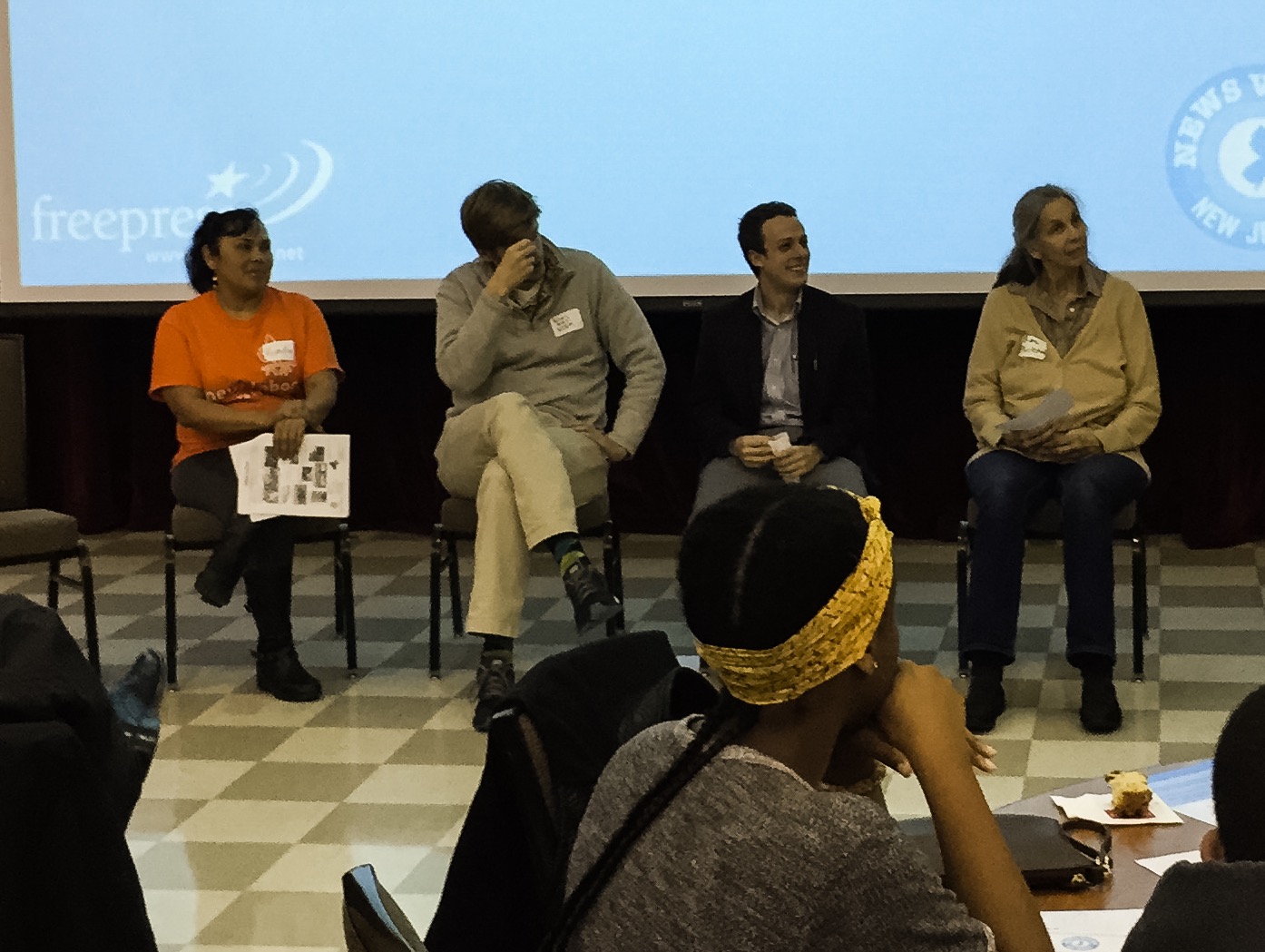
I attended a community forum last night on the state of local journalism sponsored by the Free Press‘ New Voices project. The aim of the event was to connect journalists to community members in New Brunswick and to reinforce the importance that both play in maintaining an informed and engaged citizenry.
Craig Aaron, president of Free Press, summarized the event in a tweet:
Great conversation — in English and Spanish — happening tonight on future of news at #NewsVoices in New Brunswick. pic.twitter.com/NqAf8OeqCT— Craig Aaron (@notaaroncraig) November 11, 2015
During his comments, he made this basic point (summarized in my tweet):
Craig Aaron of @freepress — functioning democracy demands journalism; journalism needs democracy #NewsVoices— Hank Kalet (@KaletJournalism) November 11, 2015
Charlie Kratovil, editor of New Brunswick Today, offered a similar comment (again, my tweeted summary):
.@Charlie4Change — things work best when engaged community & when there is journalistic scrutiny #NewsVoices @freepress— Hank Kalet (@KaletJournalism) November 11, 2015
Most of the evening was devoted to small-group work, to journalists mixing with community members to ensure that citizens understand what we do as journalists and the constraints under which we operate and that journalists focus our attentions on what is most important to the community.
A lot of issues were raised, some of which will result in stories down the road, but the big takeaway (ugh, biz speak) was something I’ve been trying to impress upon my students — and before them, my reporters: Everything has to be about the reader and the community in which we work. The stories we write are not being written for the mayor or the police chief, but the mom and dad who take their kids to soccer on Saturday morning, or the worker struggling to pay bills on minimum wage.
I met a New Brunswick resident, Reynalda Cruz, who is also an activist with New Labor. The focus of her work has been on wage theft, on trying to force businesses to pay workers what they owe. The issue, despite what the Chamber of Commerce has told me in the past, is not as simple as going to the state and getting a judgment. Too many employers know that workers like Cruz have little recourse — many are undocumented and scared of doing anything that might get them deported. Employers take advantage of this.
New Brunswick has a wage theft law that gives the City Council the ability to strip business licenses from businesses who are sanctioned by the state, but it has its limitations. A New Labor member — whose name I failed to get — told me through an interpreter that he lives in New Brunswick, but works at a Princeton restaurant. Princeton has a wage theft law, but it only applies to landscapers. The upshot is that he is still waiting for his employer to make good on a state judgment.
Cruz explained, as well, that many New Brunswick residents — especially those in the Latino community — work at warehouses outside of the city. They are technically employed by New Brunswick-based temp agencies, which are not covered by the New Brunswick rules. That leaves another group vulnerable to wage theft, she said.
These are the stories journalists should be focusing on, she said.
This is not a new idea, but in an age that prioritizes entertainment value and web clicks, it has become a radical notion.
Send me an e-mail.

 Hank Kalet