
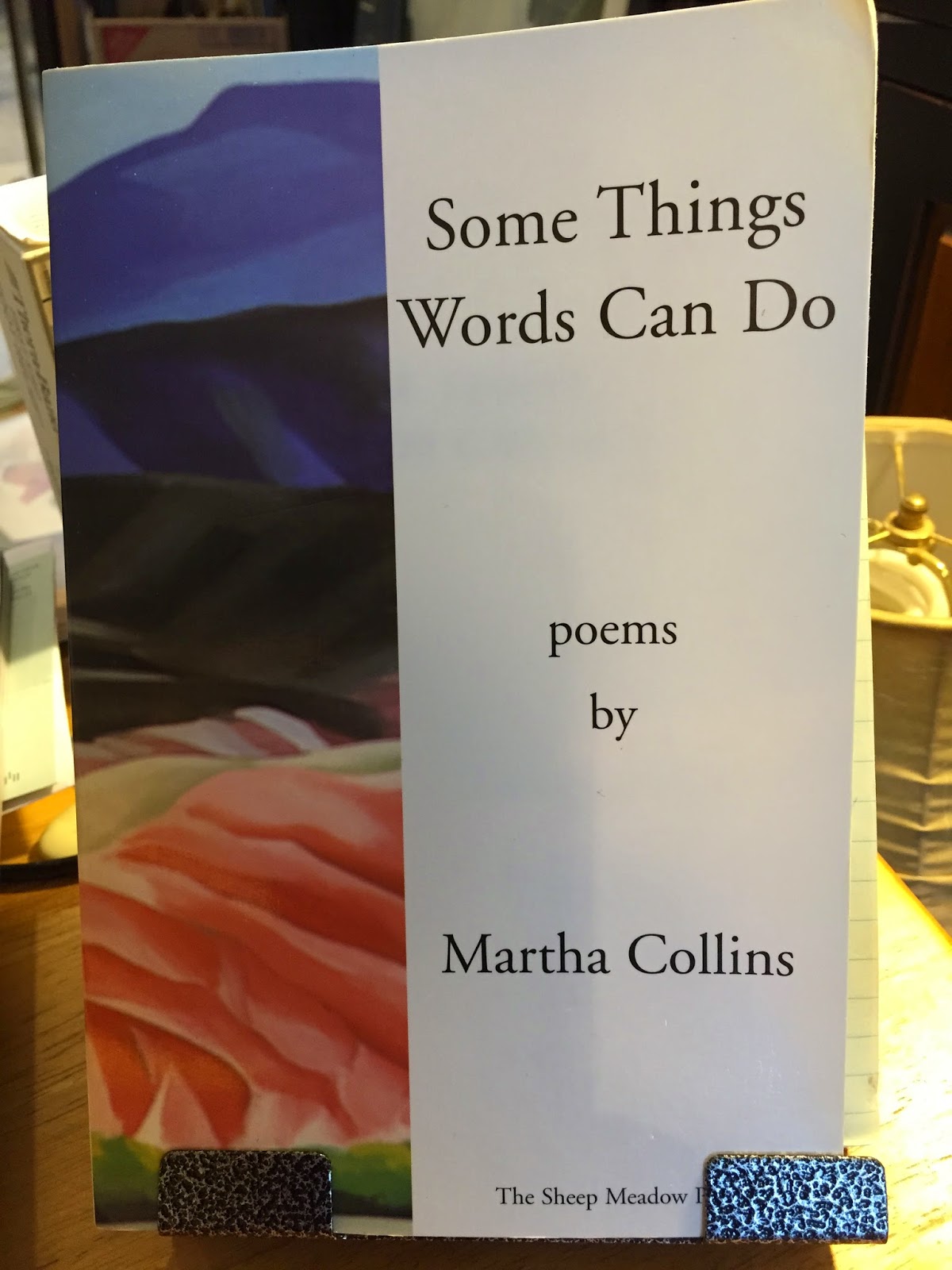
I’ve been reading an early book of poems by Martha Collins over the last few months, taking in a few pages at a time between the grading of papers, the reading of material I’ve assigned to my students and some history and fiction. Some Things Words Can Do — a collection that is actually two collections (STWCD and A History of Small Life on a Windy Planet) — is both an exploration of the uses of language (I’m playing around with a response poem now) and of the violence that seems endemic to our world. It is a work at once playful and angry, contemplative and very contemporary.
And it is a fine precursor to, though not quite as strong as, two of the books that follow — Blue Front (a major focus of my master’s thesis) and White Papers. Both of these latter books, her most recent, focus on race. Blue Front looks at how racial hierarchies and definitions often give to those who define themselves as above racial categories (i.e., whites) permission to do violence to protect these hierarchies, essentially asking questions about both contemporary and historical complicity in these crimes. White Papers, less successful artistically, explores what I’ll call the negative definition — the notion that assigning racial categories and hierarchies to the other (i.e., black Americans) also assigns them, implicitly to the majority.
If I were designing a literature class today that was designed as a response to the bubbling up of long-suppressed racial resentment and anger — brought to the surface by events in Ferguson, Staten Island, Cleveland and elsewhere — I would assign Collins’ work, along with some of the materials we have been reading in my composition class this semester (Ta-Nesi Coates’ “The Case for Reparations,” the Rev. Dr. Martin Luther King Jr.’s “Letter from Birmingham Jail,” Langston Hughes, James Weldon Johnson, Countee Cullen, Gary Soto, Claude McKay, Daniel Okita, recent op-eds on privilege by Tal Fortang and Charles Blow that take opposing points of view) and poetry by Evie Shockley, Robert Hayden’s “Middle Passage” and poems from American Journal, essays on writing by Cathy Park Hong and Jaswinder Bolina (both of which explore questions of exclusion), and some short fiction.
Anyway, this post moved in a very different direction than I intended. My original thought was just to introduce Collins so that I could link to today’s American Academy of Poets “Poem-a-Day” — “Animal / Anima” (it will appear in a future Collins collection).

 Hank Kalet