
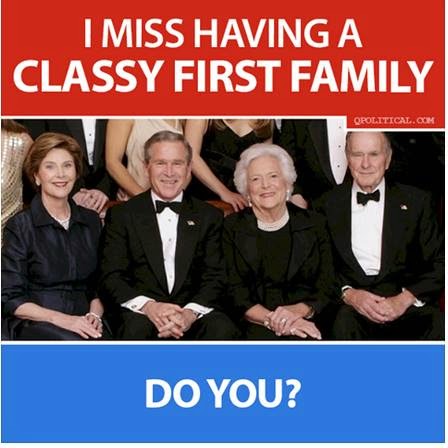
The answer is that this meme is designed to plug into racial animus while allowing a level of plausible deniability. Conservatives can post this and claim they just miss the Bushes without having to own up to the inherent racially racial underpinnings of the image and text.
I explained it this way on a friend’s Facebook page, and I think it sums up my thinking:
There is no doubt that this is built on the race/class trope, but I don’t want to go so far as to say that all who deploy it see the racial aspect overtly. It is latent, subconscious, and the poster and many of the people who would deploy this would vehemently deny any racial animus — and they would thoroughly believe their denials and are unlikely to question their own assumptions or the assumptions on which this is built. I agree … that the hate of many Obama haters has little to do with race, though the tropes — like this one — too often come back to race, partly because we are in a political climate in which everything is on the table and anything that can be used against an opponent is fair game to trot out.
So, even if the posters of the meme do not think of themselves as racist, they are trafficking in racism. When I questioned the friend who had posted this originally about his definition of “class,” he said “he knows it when he sees it.” But what does he see? And is he willing to questions the assumptions that underlie what he sees?
That is, as I said later in the same Facebook discussion, “part of the difference between the fundamentalist mindset and others — the ability to look inward and to examine one’s beliefs, assumptions, etc.”
We all have assumptions and biases that control much of our thinking, but intellectual growth demands that we constantly challenge them. This kind of post, however, allows for the bunker response — when called on its underlying racism, the poster can plausibly deny the connection and claim that the critic of the post is being overly sensitive or dogmatic on the other side. Sadly, that is the state of our public discourse these days.
It is, as the phrase goes, “dog-whistle politics,” the use of a phrase that has a certain meaning to certain people, and that is designed to rally the faithful without raising the hackles of the rest of us. “I’m not talking about race,” the argument goes, even as the meme connects with the undercurrent of racism that continues to exist in polite, middle-class society. It is more subtle than the Jesse Helms “Hands” ad or the Willie Horton ad used by George H.W. Bush against Michael Dukakis in 1988. But it plays to the same instincts, nonetheless.
Send me an e-mail.

 Hank Kalet