
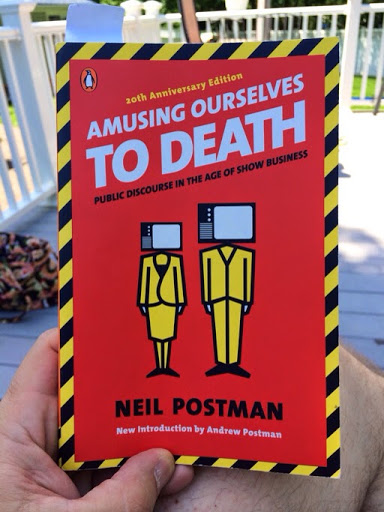
What we blame on the Web really goes back to the telegraph and other mass-communications tools, as Neil Postman points out in 1985:
(Most) of our daily news is inert, consisting of information that gives us something to talk about but cannot lead to any meaningful action. This fact is the principal legacy of the telegraph: By generating an abundance of irrelevant information, it dramatically altered what may be called the “information-action ratio.”
Information, he writes, was divorced from context, creating a flow of disconnected headlines that carry equal weight, regardless of geography or political impact. Think of the cat recently that fought off the dog attack. What relevance does it hold for most of us beyond acting as a conversation starter?
(The) situation created by telegraphy, and exacerbated by later technologies, made the relationship between information and action both abstract and remote.
Rather than reading about crime in our own neighborhoods, we now read about crime everywhere, which distorted crime’s impact and stripped us of a sense of agency or “potency.”
The “whole world became the context for news,” Postman writes. “Everything became everyone’s business.” And ultimately nothing was our business, leaving us feeling politically neutered.

 Hank Kalet