

It took minutes, really. I received an alert on my phone from the Associated Press at 3:33 p.m. and went to the Web for confirmation and something I could post with a tweet on the great Ralph Kiner. Before I could even do that, however, I saw this tweet:
BREAKING: Ralph Kiner, @Mets broadcasting legend and Hall of Fame Pirates player, dead at 91. http://t.co/lXs9moql5O –@NYDNSports
— New York Daily News (@NYDailyNews) February 6, 2014
I immediately retweeted and then tweeted this out:
Found this photo of #RalphKiner from glory days of #Mets broadcasting — w/Murphy & Nelson, a great announcing team. http://t.co/szihEQ4Lcb
— Hank Kalet (@newspoet41) February 6, 2014
My Twitter account is linked to my Facebook account, so the tweets hit Facebook and Mets fans started commenting, remembering Kiner and those early days when it was OK for the Mets to be bad and when we were fans of the men in the booth as much as we were of the team itself.
Kiner’s death at 91 is not major news, unless you’re a baseball fan — great Pirate slugger, great Mets broadcaster — but the conversation that took place on Facebook and Twitter proves the value of both social media sites.
Social media is sometimes dismissed as vanity writing, a chance to basically vomit out every thought that comes to our mind or to recount the slightest minutiae of our days. That’s certainly a part of what happens on social media. But if that is all you see, you are missing its impact as a news vehicle and as a way of generating engagement with audiences.
I always ask journalism students when major news breaks how they heard about the news. Where did they see it first. When I was a kid, the answer was television — the sudden breaking-in to a show by a news anchor with the news that Richard Nixon resigned, for instance. Before that, it was radio — think of the stories people tell of how they heard about Kennedy’s assassination.
The answer today is simple: Social media.
Think about how this works: I post the Kiner story to my Facebook page. My friends comment and then comment upon each other’s comments and we have a conversation online, group reflection perhaps. As this is happening, their friends may jump in, but they are also sharing the story on their Facebook page, expanding not only the story’s reach but the discussion about the story.
The same thing happens with all kinds of news — and not always for the good (think of the recent panic that spread across social media regarding a not-really-pending 30-inch snowstorm.) Of course, only the technology is new — we’ve always spread our news through social networks, only it was done word of mouth. Now, the technology allows for massive distribution and journalists need to understand this and continue not only to improve our social media skills but to innovate, to find newer and better ways to research/report, tell and market our stories.Consider this story and chart from The Atlantic, which I had read just an hour or so before the Kiner news hit the wire:
And Just Like That, Facebook Became the Most Important Entity in Web Journalism
The graph above tells maybe the most interesting—and definitely the most surprising—story of the past year of digital media.
It shows two years of referrals from Facebook and Google to the Buzzfeed Partner Network, a collection of websites (including this one!) that share their traffic stats with Buzzfeed. It quantifies what so many publishers have experienced: a massive surge of traffic from Facebook, unparalleled in its regular, day-after-day size and scope.
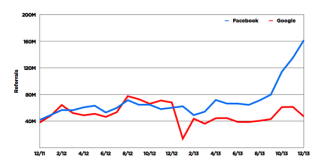
Facebook, basically, has become the most dynamic and useful distribution mode for Web journalism that exists today, more effective than Google and still stronger and more functional than the upstart social media. There are a lot of reasons for this — the ease of sharing stories, for sure, and sheer amount of time we spend on the social media site. But Facebook also offers journalism something else: A better and more diversified way to engage with stories — see above — than the traditional commenting function or the letter to the editor.

Journalists not only should be tweeting out their stories, but engaging their audiences — asking for help in reporting, joining the comment fray on Facebook and Twitter — and making clear that the process is an open-ended one. The more engaged the journalist is with his or her audience, the more engaged the audience is going to remain and the more likely it is that the story will move around the Web.
Journalists are in the business of collecting and disseminating information and creating opportunities for discussion and debate. Facebook, Twitter and other current social media do not replace journalism or journalists, but expand our tool box.
Send me an e-mail.

 Hank Kalet
This is off topic but have you ever noticed how the volume goes up when the sports guy or gal has his/her segment on the local TV news. The sports person is practically yelling and everything seems to be funny and a joke. Lot's of yucking it up, over emoting, hamming it up, lots of banter between the sports announcer and the other news readers on the nightly news. Hey, how about dem Yankees, yuck, yuck yuck, ha, ha, ho, ho. Why do most sports announcers appear to be far right wing Neanderthals with a permanent sarcastic sneer etched on their faces. All the sports announcers on all the channels, ABC, NBC, CBS, etc., seem to read from the same script and have the same loud style. They no longer wear the loud suits and loud ties of the 1970s but they still engage in the same theatrics for the most part.