
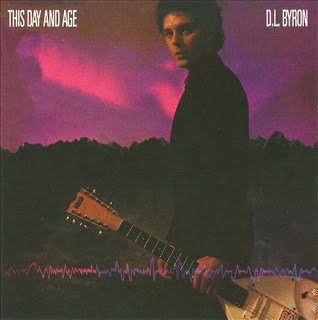
D.L. Byron‘s career proves there is no justice in the music business.
The New Jersey musician released one of the great power-pop/new-wave records in 1980, an explosive, non-stop rocker that put so much of what became new-wave radio fare to shame, and yet he has become little more than a footnote.
This Day and Age, released in 1980 on Arista Records and sadly still not available on iTunes, is characterized by a sound that is one part Byrds, one part Springsteen, one part pub-rock a la Elvis Costello and Graham Parker, with a amphetamine rhythm section. The opening track, the short, punchy “Listen to the Heartbeat,” kicks off what is 30 minutes of open-the-window and step-on-the-accelerator pop that does not let up. There are no bad songs on this record and, by all rights, Byron should have become a star. That he didn’t owes to the inability of Arista — and later, other record companies — to let him do his thing.
As Allmusic.com tells it, Byron recorded the demos for a second Arista album, including the song “Shadows of the Night.”
Arista, however, told Byron that “Shadows of the Night” and the other songs were not commercial enough and promptly put him on suspension for a year. Later, several other artists recorded “Shadows of the Night,” the most famous of whom was Pat Benatar. Benatar used the song as the opening track on her 1982 Get Nervous LP, which went on to sell over four million copies. “Shadows of the Night” won the 1982 Grammy Award for Record of the Year and has since been included on several compilations and greatest-hits packages.
Byron (@dlbyronzen) asked out of his contract, focused on songwriting and fell in with drugs, according to Allmusic. He returned in the 1990s with some solid recordings — and you can get a great live album via iTunes that showcases his live show circa 1980-1981, but nothing he has done in the last 30-plus years matches This Day and Age for its intensity. It is an album that still stands with the best of its kind.
Send me an e-mail.

 Hank Kalet