
 |
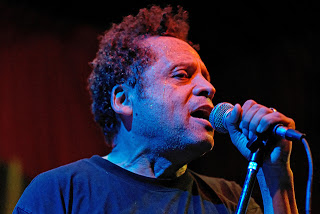
| Garland Jeffreys in Houston (garlandjeffreys.com) |
This is the first of what likely will be a sporadic take on the music that moves me. On tap today, the Garland Jeffreys catalogue, which is playing while I work on some news pieces.
For many, Brooklyn’s Garland Jeffreys is little more than a footnote to rock ‘n’ roll history. And that’s a shame, because he was, for a four-year period at the end of the ’70s and beginning of the ’80s, among the best singer-songwriters around.
He was a touchstone for me, mixing politics and urban realism in his lyrics, fusing a punk attitude with his own Brooklyn brand of pub rock. His songwriting influenced not only my taste in music — he was of a piece with the New York punk and Springsteen albums I was listening to — but also my very early efforts at writing poetry and fiction. I appreciated the details and, though nearly everything I wrote at the time probably should be burned, I think he taught me something.
I first heard Jeffreys on WNEW during summer break singing a cover of ? and the Mysterians’ “99 Tears.” I ran out immediately to get the album — Escape Artist — and played the hell out of it (I still have the vinyl, though it is pretty worn). It became apparent immediately that “99 Tears” — and the other single, “R.O.C.K.” — were not exactly representative of who Jeffreys was as a singer or a songwriter. The album also contained songs like “Christine” and “Modern Lovers,” brilliant bits of reggae-tinged pop, along with “Mystery Kids,” a harder-edged rocker. There also was a bonus EP included called Escapades that includes Jeffreys’ terrifying recounting of a Miami race riot, “Miami Beach,” a song that may best be described as the American version of the Specials’ “Ghost Town.” That was 1981 and, unfortunately, it was nearing the end of Jeffreys’ breakthrough into the American conscience.
Jeffreys first received attention as a member of the band Grinderswitch and then went solo, releasing his self-titled debut 40 years ago in 1973. The album was solid, but barely hinted at the four gritty, brilliant hybrids — the last of which, Escape Artist, I mention above — that he would release a few years down the road.
First, as Allmusic.com points out, Jeffreys releases the two-sided single “Wild in the Streets” / “35 Millimeter Dreams.” The songs remain among Jeffreys’ best and are important cogs in his 1977 effort, Ghost Writer. Ghost Writer, nearly four years in the making, showcases all of Jeffreys’ talents — the gritty imagery, the pub-rock affections, the New York attitude, the tenderness he brings to a love song or a story well told. One-Eyed Jack, the follow-up, was solid, but not nearly as satisfying and probably hampered by expectations. The reality, as All Music says, is that the album “probably couldn’t have lived up to its predecessor, and it doesn’t, but it is further evidence of a songwriting talent (not to mention a singing ability that mixes Dion with Mick Jagger) deserving of more notice than it has gotten so far.”
The two albums that followed, however, did live up to Ghost Writer. American Boy and Girl (with its street-wise lyrics and stories and the beautiful “Matador” and “If Mao Can See Me Now”) and Escape Artist.
A very good live album — Rock and Roll Adult — and an overproduced attempt to hit the pop charts — Guts for Love — followed, but Jeffreys’ career ran out of steam. His output has been sporadic — just three albums, all very good and bordering on exceptional, with 1992’s Don’t Call Me Buckwheat possibly being the strongest of his career.
As I said, that is a shame. Jeffreys deserves more attention than he has gotten.
Send me an e-mail.

 Hank Kalet