
 |
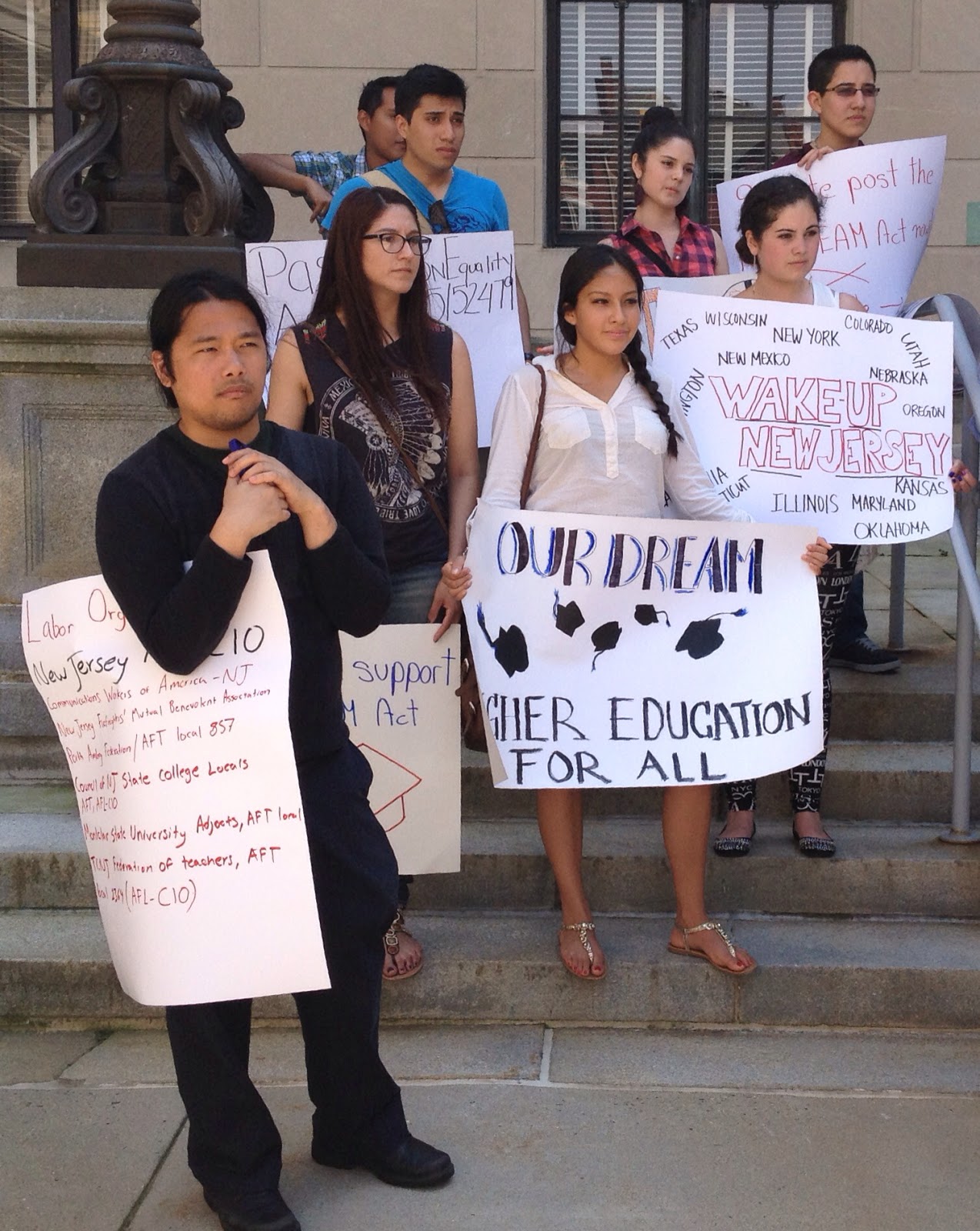
| Supporters of the Tuition Equity Act rally outside the Statehouse after the Assembly Budget Committee vote on Monday. |
Gov. Chris Christie has been pretty clear in the past: He opposes what has come to be called tuition equality for undocumented students.
Here is what his press office sent me yesterday for a story I did for NJ Spotlight on yesterday’s hearing on the Tuition Equality Act. I was seeking comment from the governor on the legislation, which was cleared by the Assembly Budget Committee on an 8-4 party-line vote. The governor, his spokesman Michael Drewniak said in an email, does not comment on pending legislation; his press office, however, does provide previous, related remarks. He offer three quotations from 2011:
From a Sayreville town hall in September 2011:
On the other side of it, you have people who have advocated for instate tuition being given for the children of people who are here illegally. Now, I can’t favor that, because we need to have an immigration system where people follow the rules, and — and I, I can’t in a difficult time of budget constraints support the idea that we should be giving money in that regard to people who haven’t followed the rules, and take that money from people who have.
From a Toms River town hall in June 2011;
Not on my watch. I’ll veto it. Listen this issue came up during the transition. They tried to pass a law like that during the transition, it didn’t pass, but I made it very clear during the transition that if I were Governor at the time I would veto it. Governor Corzine signaled he would sign it but he could not get the votes in the Legislature to pass it and I think the Legislature won’t even attempt to do that now because I’m very clearly on the record on that issue especially in times like this where we are so fiscally challenged. Those types of breaks that we give need to go to those who are paying the taxes to support.
And from an “Ask the Governor” appearance in March 2011:
Well first off with illegal immigration in this country is an enormous issue, A federal issue that the federal government has to get under control. Now in terms of services that are provided inside the state, what you’re talking about predominantly is kids who go to school whose parents have come here illegally, and you have some health care that’s provided though hospitals and charity care so those are policy decisions that we’ve made as a state. If children are born here, they are here and their parents are here illegally, do we penalize the child by not educating them? And additionally if someone shows up sick or dying in an emergency room do you not treat them? I mean as a policy judgment as a state we’ve decided to take care of those things. But the bigger issue they’re talking about is we’ve got to get this immigration situation under control in this country is the federal government and take it from me as a former federal prosecutor it’s the only way you’re going to fix it through the federal government coming up with a new scheme to govern immigration in our country.
So, the governor has been pretty clear about where he stands. And given his apparent national ambitions and the reality that no Republican will be able to survive a national Republican primary campaign if he is seen as being soft on immigration issues, no one should expect him to change his mind.
That said, the wheels are turning on tuition equality. The legislation, as I write on NJ Spotlight,
would allow students who are undocumented immigrants but have received a New Jersey high school diploma to qualify for in-state tuition at New Jersey public colleges. Under the bill students “without lawful immigration status” would need to have attended a New Jersey high school for at least three years and graduated from it or received the “equivalent of a high school diploma” in New Jersey
Students would need to be attending a public college, either as new students or as returning ones, during the 2013-2014 academic year and file an affidavit with their school saying they have submitted an application to legalize their immigration status or that they planned to file an application as soon as they are eligible to do so. Students who attend county colleges in their home counties would be eligible for the in-county rates, as well.
It now goes to the full Assembly — no date has been set for that vote — and then to the state Senate. The bill is supported by the New Jersey Presidents Council, which represents all of the state’s public and private colleges, and a long list of other civil rights, immigration and labor groups. Supporters are pretty clear that this is about equality and fairness. Undocumented immigrant college students, most of whom came to the United States when they were very young and without any say about the move, are paying two to three times what citizen students and authorized immigrant students pay in tuition at schools like Rutgers, NJIT and the state college system. They pay significantly more at the county colleges, as well, making schools like the County College of Morris, Mercer County Community College and Brookdale Community College too expensive to attend.
These are students who have attended the state’s public high schools, done well and had an expectation that they would be allowed to continue. And while there are no official restrictions on their attending state colleges and universities, they are priced out.
Critics argue that tuition equality will harm taxpayers, the colleges, create a new level of competition that will harm students who are American citizens. And, they argue, allowing immigrant students to qualify for in-state tuition would reward parents for breaking the law and side-stepping the national immigration system.
Most of these arguments are specious and contradictory. Taxpayers are not on the hook for tuition now and there are no subsidies envisioned by the legislation. The colleges are on board — if college presidents thought this would damage the schools, it is unlikely they would have backed the bill.
As for the competition argument, students already compete for admission, often with foreign students, with the schools making decisions based on grades, test scores and a myriad of other factors. This won’t change if the Tuition Equality Act passes.
These arguments are really just stand-ins for a punitive approach to immigration reform that focuses on border control and seeks to withhold all benefits from the undocumented. There is a contradiction in a position that allows for undocumented students to attend public schools, but then refused to allow them to qualify for in-state tuition at public colleges. The reality is that anti-immigration groups — they not only oppose a pathway for the undocumented, but generally support strict quotas and many are calling for a moratorium on all immigration — oppose provision of any public benefits to the undocumented and view immigration as an “invasion” and a dangerous dilution of Americanness.
Send me an e-mail.

 Hank Kalet