
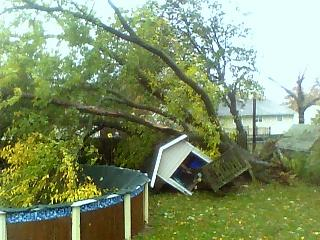
It’s been quiet here so far, but not everyone has been so lucky. Here is a photo from friends in Piscataway — a tree took out an old playhouse in their yard, which is probably a lucky stroke as well. Had the tree fallen the other way, who knows.
This is just the initial strike, just the early wind and rain in a storm that has not even made landfall. According to NJ.com,
In its 2 p.m. briefing, the National Hurricane Center said Sandy is now moving northwest at 28 mph, with maximum sustained winds of 90 mph, and set to make landfall as the most powerful hurricane to ever make landfall in New Jersey.
The hurricane has accelerated dramatically since the last briefing just three hours ago, with New Jersey bracing for the most intense weather starting to occur in the southern and central coastal areas. Now just 110 miles away from land, Sandy is already hammering New Jersey with lashing winds and flooding rains, bringing rail and road travel to a near standstill. Government offices are shuttered and towns along the coast have been evacuated.
Here in South Brunswick, there are reports of power outages. Friends in Kingston have been without electricity for most of the day and
Police spokesman Sgt. Jim Ryan said the high winds caused downed wires on Georges Road near the Wetherill House.
“We’re expericing more power outages as the storm progresses,” he said. “We’re still trying to determine the extent of the outages at this time. The wind is also causing a lot of downed trees in the area.”
Earlier, police reported
South Brunswick Police are reporting power outages along Route 27 near the Franklin Township border from Route 518 to Promenade Blvd., with some traffic lights on flash.
Broadway Road remains closed due to a fallen tree near Miller Road. Downed trees have also been reported on Riva Ave by Davidson Mill Road, Selma Drive, Georges Road by Deans Rhode Hall Road and on Deans Rhode Hall Road as well. Eiker Road by Rowland Park has been completely blocked by a downed tree.
Police spokesman Sgt. Jim Ryan said a roof partially blew off of Dayton Collision on Route 130, next to Dayton Toyota.
The Shore area already is underwater and New York City is experiencing flooding. And this is before we feel the brunt of Mother Nature’s strength.
No one weather event can be used to prove climate change, but there is a “bounty of scientific and statistical evidence now in hand” making it clear that Hurricane Sandy is part of a larger pattern of weather change being created by our warming world.
Today, another multibillion-dollar weather disaster — the very sort that scientists have been predicting for years would increase in frequency and intensity as the planet heats up — is now bearing down on the American East Coast. Roads and subways and homes will flood and lives might well be lost (the death toll in the Caribbean already is as high as 65). Property damages from wind and storm surges could break records. And as many as 10 million people will likely lose power once Hurricane Sandy comes ashore somewhere along the New Jersey coast later tonight.
Sandy — like Irene and other megastorms in the recent past — are being fed by increased ocean temperatures, according to Michael Mann, a physicist and the director of the Earth System Science Center at Pennsylvania State University. He told The Huffington Post that “climate change is playing a role in setting the context for these storms, in particular the record levels of North Atlantic ocean warmth that is available to feed these storms with energy and moisture.”
Another research scientist, Kevin Trenberth, head of the Climate Analysis Section at the USA National Center for Atmospheric Research and one of the world’s foremost experts on changes to global energy and water cycles, told The Huffington Post that Hurricane Sandy may be the “new normal.”
“Climate change is changing the weather,” Trenberth said. “The past few years have been marked by unusually severe extreme weather characteristic of climate change. The oceans are warmer and the atmosphere above the oceans is warmer and wetter. This new normal changes the environment for all storms and makes them more intense and with much more precipitation.”
And yet, nothing during the debates — not a question from the moderators or any real sense of urgency from the candidates. No one wants to talk about the damaging effects of our addiction to oil, of our over-building and complete lack of regard for the natural landscape because that would interfere with corporate profits, which is the only thing that matters in American politics.
Chris Hedges today makes the point that the current political system is bankrupt and genetically incapable not only of challenging corporate power but of even doing the smallest things to help level the playing field. A mass movement is our only hope:
All the major correctives to American democracy have come through movements and third parties that have operated outside the mainstream. Few achieved formal positions of power. These movements built enough momentum and popular support, always in the face of fierce opposition, to force the power elite to respond to their concerns. Such developments, along with the courage to defy the political charade in the voting booth, offer the only hope of saving us from Wall Street predators, the assault on the ecosystem by the fossil fuel industry, the rise of the security and surveillance state and the dramatic erosion of our civil liberties.
He calls for an abandonment of the two-party system, with a vote for third-party candidates (Green Party candidate Jill Stein is his choice). And he damns those who will hold their nose and vote for President Obama and as “assur(ing) our mutual destruction.”
There is a danger in following his lead. He is right that we need a mass movement to create the moral and ethical momentum and that a progressive third party offers us a better chance of making change than to continue to back a bankrupt Democratic Party. But the Greens — like every other third party now in existence — are just too weak to be able to force that change. A vote for Stein ultimately is just a vote cast in a vacuum, one that carries with it the very real possibility that it will empower the GOP.
The movement Hedges calls for is in its infancy and just not strong enough to sustain the potential stain of apostasy that will be heaped on it by mainstream liberals. That ultimately was the problem with the 2000 Nader campaign. Rather than showing strength on the left, Nader’s failed candidacy was blamed for Al Gore’s loss — and George W Bush’s win. The lack of a strong left movement in 2000 left Nader vulnerable to the charge and has now left him a pariah among some on the left.
We are facing the same kind of conundrum today. Obama does not represent change or progress, but handing the reins of government over to the GOP will do far more damage at this point than we can afford.

 Hank Kalet