
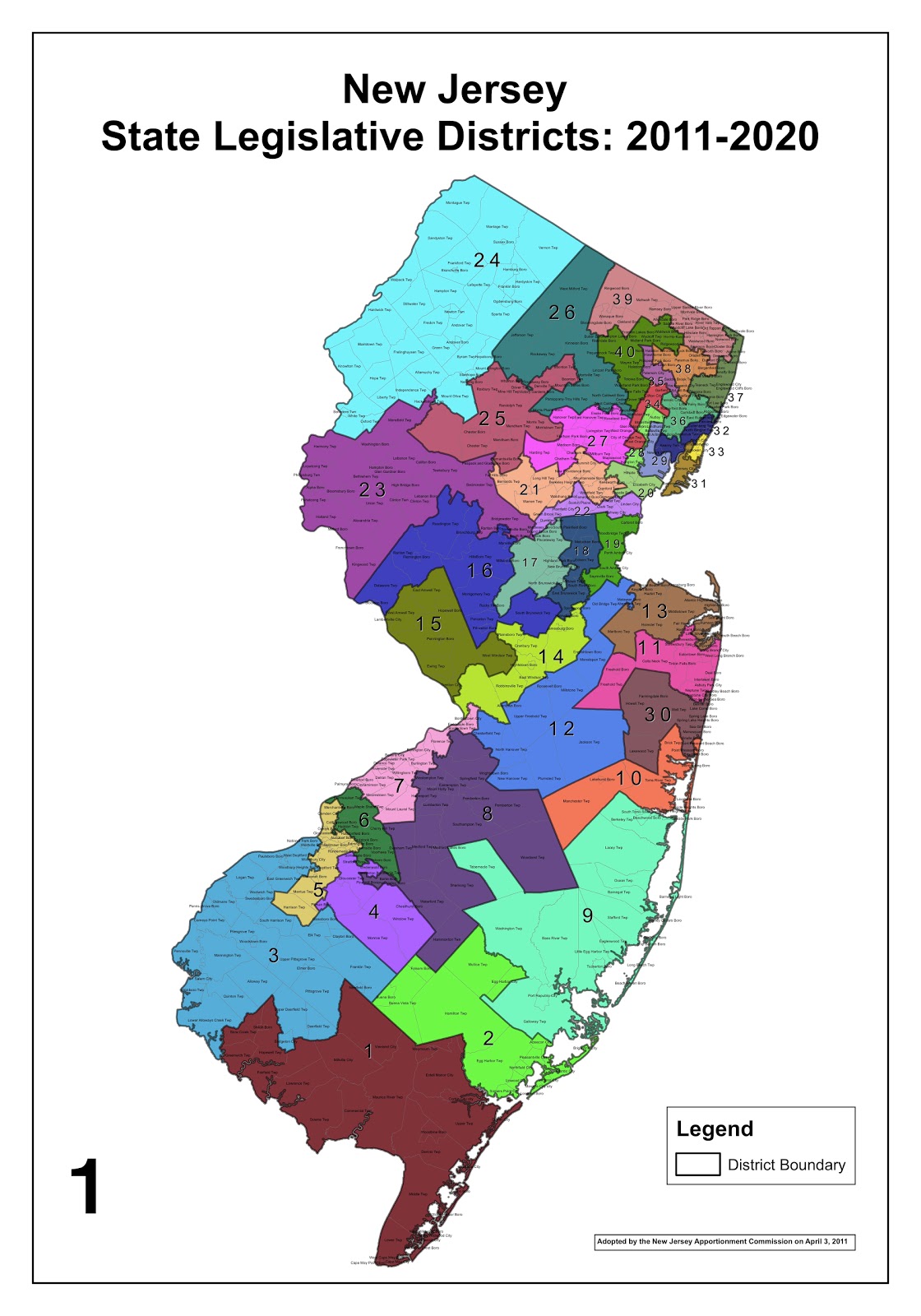
Democrats are happy with the new legislative map approved by the state’s redistricting commission, for no other reason than it is likely to preserve the party’s control of both houses of the state Legislature.
 |
|
| The final map, courtesy of the New Jersey Department of State |
The Democrats’ attitude can be summed up pretty succinctly with this quotation from Mark Magyar’s story on NJ Spotlight:
“I’m keeping 24!” said an elated Senate President Stephen Sweeney (D-Gloucester), whose party holds a 24-16 majority.
Alan Rosenthal, the Rutgers professor brought in as the 11th member after it was clear that the two parties had deadlocked, listed his goals for the process early on, so the outcome here should not surprise anyone.
But Rosenthal’s goals — like the entire process — were badly flawed. Rosenthal privileged continuity of representation above nearly every other goal, which meant that any map he was likely to back would be one that would safeguard incumbents.
In a state as dysfunctional as New Jersey, however, one has to wonder why anyone would want to make it easy for the majority of legislators — the people who have helped create the mess the state is in — to keep their jobs.
The result is a map, as Magyar points out,
makes it likely not only that Democrats will continue to hold their majorities in both the state Senate and the state Assembly in next November’s election, but also that 90 percent of incumbent legislators will be reelected with relatively little difficulty.
The goals should have been:
- increased minority representation in the state Legislature
- districts that are compact geographically (there are too many districts under the new plan in which towns — see South Brunswick in the 16th — are connected to the rest of their district by only a sliver of common border)
- competition in as many districts as possible
These goals, however, would challenge the status quo and endanger too many sitting legislators.
Republicans, at the moment, are crying foul, but their map was only nominally better — it was designed to increase the number of Republicans and would have committed some of the same sins committed by the new map.
The effort raises some additional questions about the composition of the state Legislature and whether the static 40-district model makes sense, whether we should experiment with other forms of representation and why we have allowed the public-financing initiative to die.
New Jerseyans might be better served by a constitutional change that ties the number of legislative seats to population rather than apportioning 40 districts across a shifting population. Or, there could be a hybrid arrangement that allows for some members to be selected through proportional representation.
There are numerous possibilities. What the latest round of redistricting proves, unfortunately, is that our system of drawing boundaries is badly flawed and needs to be changed.
- Send me an e-mail.
- Read poetry at The Subterranean.
- Certainties and Uncertainties a chapbook by Hank Kalet, will be published in November by Finishing Line Press. It can be ordered here.
- Suburban Pastoral, a chapbook by Hank Kalet, available here.

 Hank Kalet