
The lines are going to shift. That much we know. And once they do, it is likely that the Democrats will still control a majority of legislative districts in the state — that’s what Patrick Murray thinks, anyway.
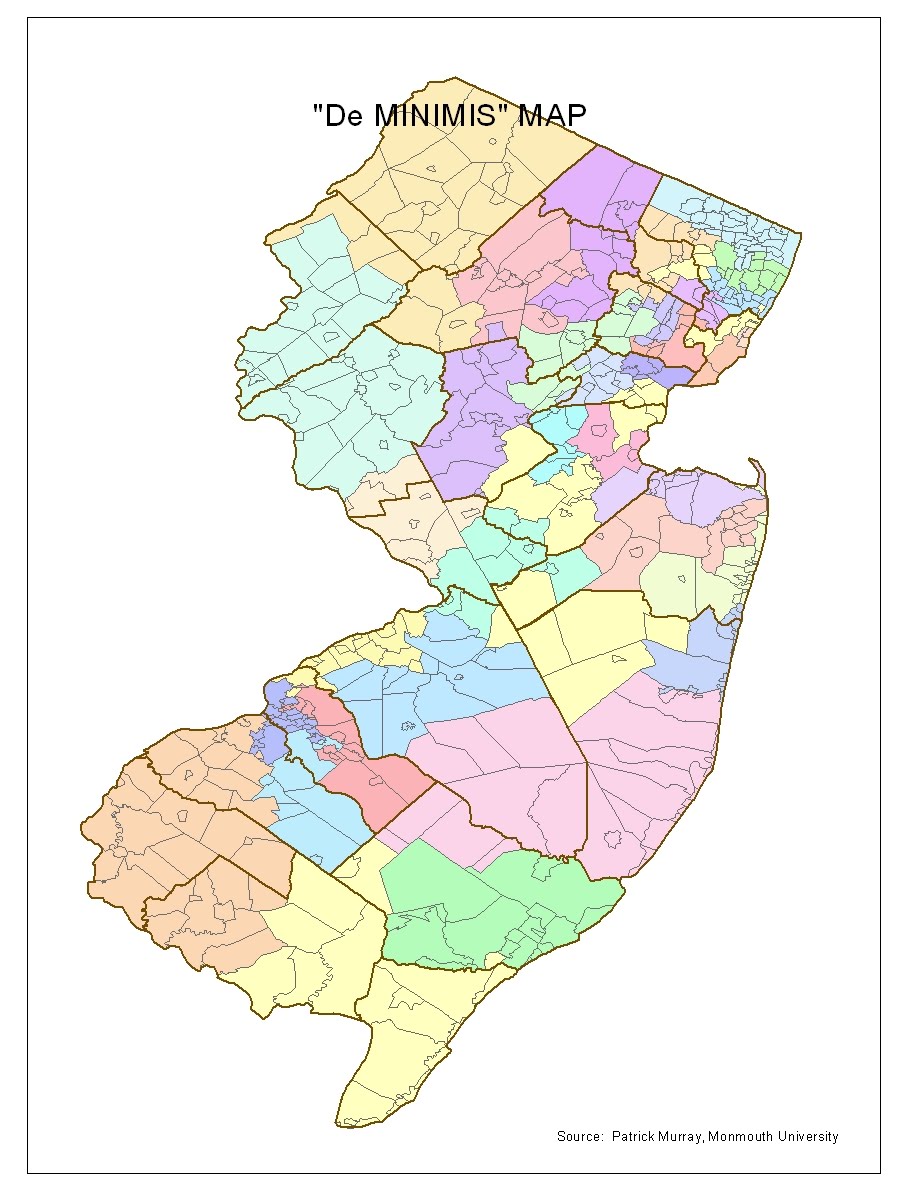
The map he included with his latest blog entry — one based on a memo purportedly distributed by Alan Rosenthal, the Rutgers professor who will be the deciding 11th vote on the redistricting commission.
Murray says that Rosenthal has set his sights on stability, meaning that he will push the commission to avoid large-scale changes. The memo, he says, outlines five basic standards: population range, contiguity, compactness and avoiding municipal splits, and “contiguity of representation.’
Taken together, Murray says, the standards “allow for very little change to the current map.” And that, he says, is consistent with Rosenthal’s writings. He calls this believe “the money card in Rosenthal’s standards”:
Rosenthal defines this as incumbents facing a familiar electorate. In other words, incumbents should be drawn into districts where the majority of voters are already represented by them. You could also call this the de minimis rule – any change should not be consequential to the current system as a whole. Anyone who has worked with Dr. Rosenthal or read his published works on state legislatures will not be surprised by how much he values this type of continuity.
The problem, as Murray points out, is that Rosenthal has little interest in competitiveness (neither party is interested in competitiveness; they would prefer to see uncompetitive districts that protect as many of their own as they can draw). In a state with few competitive districts — the 14th, the 12th, maybe one or two others and this assumes a rather loose definition of competitive — that leave entrenched power in place.
Power shifts are rare in the state — Democrats took control in the 1970s after Watergate and Republicans took control temporarily in the early 1990s in reaction to the Florio tax hike and watched their majority slowly slipped away.
The redistricting discussion is treated as a partisan debate, but it should be viewed as a chance to improve representation, to expand democratic opportunities. If that means a shift in party power, then so be it.
Locally, it appears, the 12th, 14th, 15th, 16th, 17th and 18th districts — which cover most of central New Jersey — are likely to see significant change. South Brunswick is likely to be moved, as is Monroe, but it is unclear where they will end up. If Plainsboro stays put — and it should remain connected to West Windsor — then Linda Greenstein will be losing a large chunk of her voters. South Brunswick’s power could grow if moved to a district that includes the other Brunswicks, because it would mean most of the towns would be about the same size.
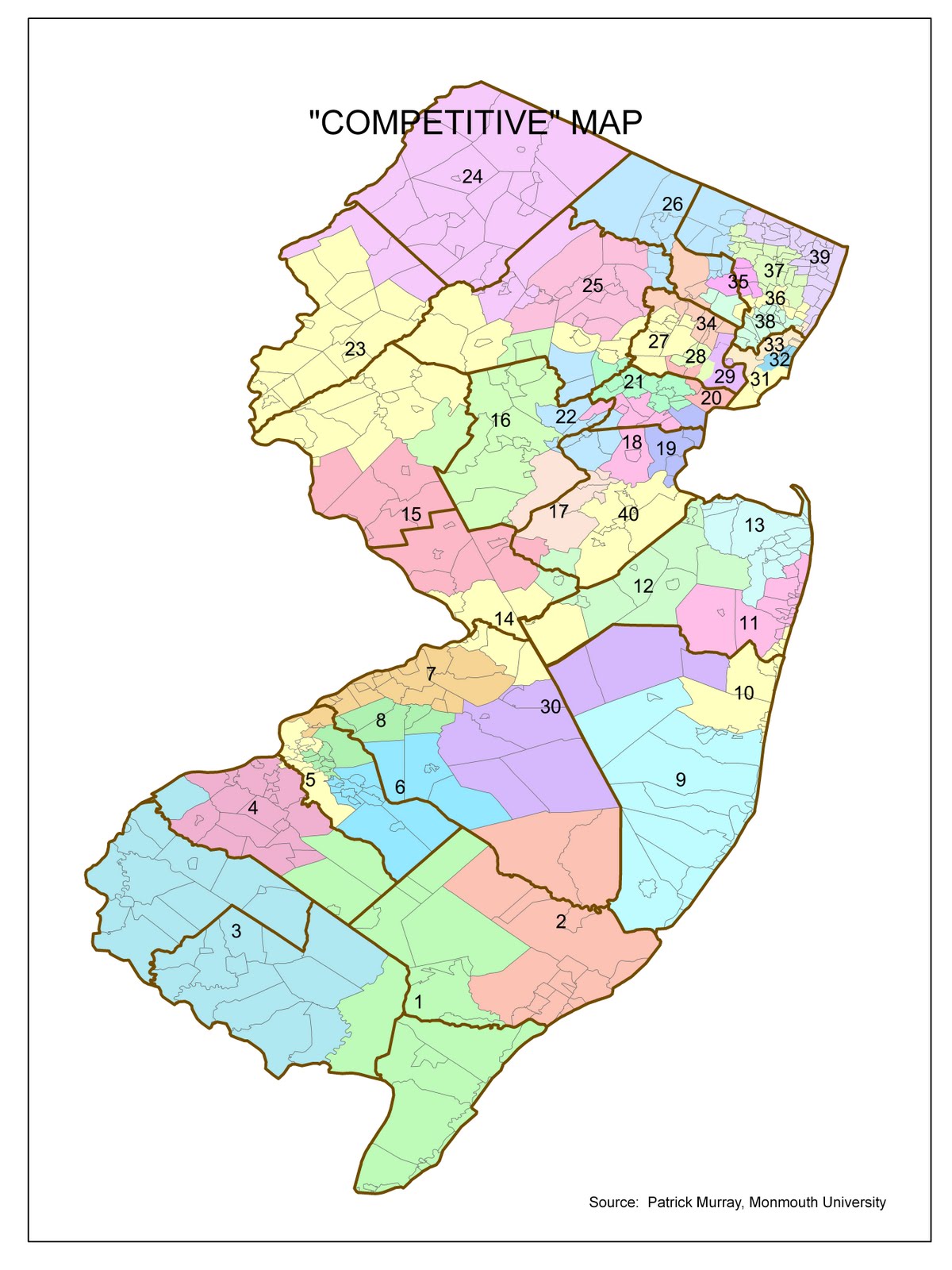 The “De Minimus” map I’ve included with this post has South Brunswick, Monroe, East Brunswick and Franklin making up a new district. What’s left of the current 14th would be filled out with East Windsor, Hightstown, Robbinsville and Millstone; the 15th would get southern Hunterdon County and so on.
The more competitive map favored by Murray (left) would pair Hamilton and Trenton in a new 14th filled out with parts of Monmouth and Burlington counties; South Brunswick would move to the 17th with Franklin and North and New Brunswick; East Brunswick, Old Bridge and Monroe would make up part of a new 40th district.
Is this better? Hard to say. It certainly shifts more bodies around, but does it create better representation? Murray thinks so.
In any case, maybe the lines mean a lot less than we think. Maybe we just need a better class of candidate.
- Send me an e-mail.
- Read poetry at The Subterranean.
- Certainties and Uncertainties a chapbook by Hank Kalet, will be published in November by Finishing Line Press. It can be ordered here.
- Suburban Pastoral, a chapbook by Hank Kalet, available here.

 Hank Kalet