
The intersection of faith and public morality too often is derided or, at the very least, cast on the shoals of the church-state debate.
Let me say, first off, that the wall Jefferson wrote separating religion from government is one of the most important constructions devised by the founders. It protects religious minorities amd the irreligious from the majority and the state and, avoid unnecessary and dangerous entanglements, while creating space for religion to grow and prosper.
That is why the religious culture of the United States is healthier and more diverse than in most European nations. There is no war on religion, despite what Bill O’Reilly and his neandethal brethren say, (I would argue, in fact, that if anyone is doing harm to religion in the United States, it is folks like O’Reilly and the American Taliban).
The Constitution prohibits government involvement or endorsement — which I read to include religious holiday displays on government properties — but not public involvlement. Churches and synagogues and mosques and all other religious groups are free to display their symbols publicly — as the Chabad does in South Brunswick, with its massive menorah on its Route 130 property.
More importantly, religious congregations, clergy and parishioners are free to engage in the political debates of the day (though specific churches and denominations cannot endorse because of their status as nonprofit entities).
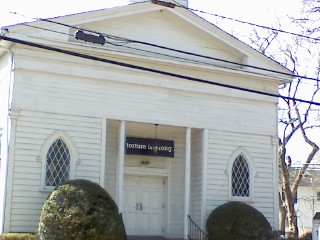
Religion, as the banner hanging from the Witherspoon Street Presbyterian Church in Princeton makes clear, has a lot to say about the issues of the day. In this case, the “Torture is wrong” is proclaimed.
There is the clergy component of the battle against poverty in the state, the clergy letter condemning the death penalty, the Catholic Church’s “Just War” theory, the civil rights movement and so on. We don’t need to agree with every decree — the Catholic Church is wrong on homosexuality and abortion is a private matter best left to individual women to wrestle with — but we should acknowledge the role religion can play in the debate.
I write this not in response to any specific news event, but because I saw the banner on the church as I walked from by office to a downtown deli. It hit me that, while there are people like Christopher Hitchens who see the religious as superstitious nits, the reality is that the mass of believers out there is a rather complex and diverse lot that reflects who we are in all of our imperfections.
What makes our democracy work is the cacophony of voices, secular and religious, liberal and conservative, and the miraculous music it can make when each voice is willing to make room for the other.

 Hank Kalet